Mechanics-Embedded Diffusion with Closed-Loop Denoising for Intelligent Zoning Design of Concrete-faced Rockfill Dams
Jin Han 1, Wenjie Liao 2, *, Xinzheng Lu1, *, Yi Gu 1, Zongliang Zhang 3, 4, Biao Liu 3, Zhijie Duan 5
1. Department of Civil Engineering, Tsinghua University, China
2. School of Civil Engineering, Southwest Jiaotong University, Chengdu 610031, China
3. China Renewable Energy Engineering Institute, Beijing 100120, China
4. Power Construction Corporation of China, Beijing 100085, China
5. School of Civil Engineering, North China University of Technology, Beijing 100144, China
* Correspondence: Wenjie Liao (Email: liaowj@swjtu.edu.cn; Tel: +86 18782900404); Xinzheng Lu (Email: luxz@tsinghua.edu.cn)
Advanced Engineering Informatics, 2026, 76: 105020. DOI: 10.1016/j.aei.2026.105020
Abstract
Generative Artificial Intelligence holds great promise for automating design in construction. However, existing data-driven approaches often prioritize geometric plausibility over mechanical performance, making it difficult to guarantee safety compliance. Therefore, this study proposes a mechanics-embedded diffusion framework that incorporates mechanical constraints into training via the loss function, and, more importantly, embeds mechanical feedback into the inference stage by modifying the denoising process. Specifically, a surrogate model is constructed to evaluate structural stability (e.g., anti-sliding), from which a differentiable mechanical loss is derived. During training, this loss enables the model to learn safety-aware distribution-level priors, while during inference, it provides stepwise feedback to dynamically update design conditions, enabling closed-loop instance-level mechanical correction throughout generation. Validated through the zoning design of Concrete-faced Rockfill Dams (CFRDs), the method effectively improves mechanical compliance and cost efficiency without sacrificing generative accuracy. In a test case, the shares of high-cost zones were reduced by 10.17% (primary rockfill) and 4.87% (modulus-increased zone), validating the method's efficacy for mechanics-embedded automated design.
Keywords
Intelligent zoning design of rockfill dams; Mechanics-embedded training; Mechanics-embedded inference; Diffusion model; Feature-space–based representation
1 Introduction
Earth and rockfill dams are widely used in reservoirs and flood-control infrastructure, owing to their multiple advantages, including the ready availability of materials, mature construction techniques, and relatively low cost [1]. Globally, these dams account for over half of the large hydraulic works, and in China, they comprise more than 90% of reservoir dams [2]. Among them, concrete-faced rockfill dams (CFRDs) are a principal form of modern high dams, recognized for their superior seepage control, deformation adaptability, and cost-effectiveness [3]. With the increasing demand for renewable energy and disaster-mitigation projects, the demand for CFRDs continues to grow, making design efficiency and quality the critical research priorities.
However, traditional CFRD design largely relies on empirical formulas, finite-element analysis, and multiple rounds of manual iteration [4], which are time-consuming and often fail to achieve global optimality. With the development of computer-aided design in recent years, researchers have been exploring parametric design methods for the rapid modeling and geometric control of CFRDs [5]. These methods iteratively search for dam designs that satisfy specific constraints and optimization objectives, such as minimizing principal stress [6], reducing total strain energy [7], or lowering construction cost [8]. Common techniques include evolutionary algorithms [9], swarm intelligence algorithms [10], and gradient-based multi-objective optimization [11]. For instance, Mahani et al. (2015) integrated continuous ant-colony optimization with particle-swarm optimization to determine the optimal shape for double-arch concrete dams under dynamic-response constraints [12]. Liu et al. (2024) incorporated domain knowledge into a multi-objective optimization model, achieving a balance between minimal dam weight and overall tensile stress [13]. Although these approaches enhanced the automation of dam design to some extent, the optimization process depended heavily on designers’ experience and predefined parameter spaces, limiting the use of increasingly abundant historical design data and structural knowledge. Moreover, the extensive iterative search leads to high computational costs and low design efficiency.
With the rapid advancement of artificial intelligence (AI), generative AI has emerged as a powerful tool capable of learning and creating new structural schemes within complex design spaces [14, 15]. Representative generative models include variational autoencoders [16], generative adversarial networks (GANs) [17, 18], and diffusion models [19, 20]. These models can learn latent design patterns from large-scale historical data, facilitating the generation of new structural schemes that conform to specific design characteristics. In the field of buildings and construction, generative AI has been successfully applied to structural-layout design [21, 22], dimensional design [23], and structural optimization [24], demonstrating strong end-to-end learning and generation capabilities. Building on these advances, Liao et al. (2025) introduced GANs into CFRD zoning design and verified their effectiveness in improving design efficiency [25]. However, GAN-based results often suffer from blurred boundaries and irregular shapes, requiring extensive post-processing. In contrast, diffusion models have demonstrated superior generative quality and finer control over detail in both image and structural-design tasks [21], offering new opportunities for intelligent dam zoning. Nevertheless, Liao et al. (2025) primarily focused on geometric feature learning, without implementing mechanical constraints to ensure the structural reliability of generated results [25]. Therefore, a key challenge in intelligent dam design lies in enhancing the quality of AI-generated results, while effectively embedding mechanical constraints into generative models.
Embedding mechanical constraints into generative AI is most effectively achieved through mechanical surrogate models based on deep neural networks [26]. In recent years, such models have been widely applied in earth and rockfill dam monitoring and analysis [27, 28] and parameter optimization [6, 10]. Compared with finite-element analysis, surrogate models approximate high-dimensional input-output mappings using machine learning, substantially reducing computational costs while maintaining predictive accuracy. For example, Wu et al. (2025) developed a reliable dam-deformation prediction model by integrating a gated-recurrent-unit network, a self-attention mechanism, and a temporal convolutional network [29]. Hariri-Ardebili & Pourkamali-Anaraki (2022) used a surrogate model to simulate dam responses under complex conditions, supporting parametric design and uncertainty analysis [11]. These studies demonstrated that surrogate models could effectively capture key mechanical characteristics of complex structures, offering a feasible path to embed mechanical constraints into intelligent generative models. However, existing approaches primarily incorporate such constraints either during training stage or via post hoc evaluation, lacking explicit mechanisms to enforce mechanical feasibility during the generative process itself. This limitation is fundamental to generative models, which learn statistical priors of the data distribution rather than enforcing physical constraints at the level of individual samples. As a result, even when mechanical knowledge is incorporated during training, the learned model cannot guarantee that each generated design satisfies engineering requirements. The absence of feedback during the inference stage further prevents the correction of infeasible samples once the generation trajectory is determined.
To address the above challenges, this study proposes a mechanics-embedded diffusion framework with closed-loop denoising for the intelligent zoning design of CFRDs (CFRD-Mech-Diffusion). Unlike existing approaches, mechanical constraints are enforced during inference rather than only learned during training. This distinction is essential, as training-stage constraints only shape the distribution-level prior, whereas inference-stage embedding directly ensures feasibility of each generated sample under stochastic sampling.
Specifically, during training, differentiable mechanical constraints are incorporated into the loss function, enabling the model to learn safety-aware and near-optimal generative priors under given design conditions, which provide a necessary foundation for subsequent design adjustments. More importantly, during the inference stage, mechanical feedback is embedded by modifying the denoising process, enabling design correction at each generation step. Built upon the priors learned during training, this allows condition adjustments to consistently produce near-optimal layouts rather than merely feasible ones. This transforms the diffusion model from an open-loop generator into a closed-loop design system, ensuring instance-level mechanical compliance.
To support this framework, a feature-space–based data representation and dataset construction method are developed for AI-driven design (Section 3), and a surrogate model for anti-sliding stability is established using a two-stage training strategy (Section 4). Based on these components, the mechanics-embedded diffusion framework is constructed for intelligent CFRD zoning design (Section 5), followed by systematic analysis of different embedding strategies and model configurations (Section 6) and validation through representative engineering cases (Section 7).
2 Methodology
Because the cross-sectional design of a CFRD
largely determines its overall three-dimensional configuration, this study
focuses on the intelligent design of CFRD sectional zoning. In the zoning
scheme, local components such as the concrete face slab, cushion zone, transition
zone, and plinth occupy relatively small proportions and are usually prescribed
by regulations. In contrast, the major zones, including the primary and secondary
rockfill, drainage, and modulus-increased zones, play more critical roles
in dam-stress distribution and stability, exhibiting higher design complexity
that is suitable for AI-based generation [25]. In the meantime, as a key indicator
of structural safety, the anti-sliding stability directly reflects the rationality
of zoning design and overall shear resistance of the dam [30]. Therefore,
this study targets the major two-dimensional zones and introduces a downstream
anti-sliding stability safety factor (  ) constraint to develop a mechanics-embedded
diffusion framework (CFRD-Mech-Diffusion), thereby achieving efficient and
mechanically compliant CFRD zoning design. It should be noted that
) constraint to develop a mechanics-embedded
diffusion framework (CFRD-Mech-Diffusion), thereby achieving efficient and
mechanically compliant CFRD zoning design. It should be noted that
 is selected as the mechanical constraint in this study,
mainly for method validation. In future applications, one or more additional
mechanical constraints can be incorporated using the same framework.
is selected as the mechanical constraint in this study,
mainly for method validation. In future applications, one or more additional
mechanical constraints can be incorporated using the same framework.
The workflow of the proposed mechanics-embedded intelligent design method for the major zoning of CFRD is illustrated in Figure 1. Table 1 summarizes the notations of all tensors used in this study.
(1) Mechanics-embedded diffusion framework training method
(Figure 1(a); more details are described
in Section 5.2). A classic diffusion
model is constructed and trained to progressively denoise Gaussian noise into
two-dimensional CFRD zoning designs under the constraint of a design condition
tensor (  ). To further ensure mechanical compliance, the
 loss computed
from the mechanical surrogate model is introduced during the fine-tuning stage.
Through this constraint, the model learns not only the geometric regularities
of historical zoning layouts, but also the tendency to generate mechanically
safer designs under a given
loss computed
from the mechanical surrogate model is introduced during the fine-tuning stage.
Through this constraint, the model learns not only the geometric regularities
of historical zoning layouts, but also the tendency to generate mechanically
safer designs under a given  . In other words, it improves the distribution-level
safety prior of the generative model, biasing it toward layouts with higher
. In other words, it improves the distribution-level
safety prior of the generative model, biasing it toward layouts with higher
 .
.
(2) Mechanics-embedded diffusion framework inference method (Figure 1(b); more details are illustrated in
Section 5.3). To incorporate explicit dynamic
mechanical feedback during inference, backpropagation is retained during inference,
specifically within the denoising process, while keeping both the diffusion
and surrogate models fixed. The gradient of the mechanical loss (i.e., the
difference between the predicted  and code-specified
limit) with respect to
and code-specified
limit) with respect to  is computed to guide its dynamic adjustment at each denoising
timestep. Through this mechanism, the inference stage enables stepwise and
closed-loop correction of infeasible or suboptimal configurations without
modifying the underlying generative model.
is computed to guide its dynamic adjustment at each denoising
timestep. Through this mechanism, the inference stage enables stepwise and
closed-loop correction of infeasible or suboptimal configurations without
modifying the underlying generative model.
Notably, in this study,
closed-loop means that the inference stage is no longer executed under fixed
 . Instead, at each denoising step,
the current predicted layout is evaluated by the surrogate model, and the
deviation between the predicted mechanical performance and the code-specified
requirement is fed back to update
. Instead, at each denoising step,
the current predicted layout is evaluated by the surrogate model, and the
deviation between the predicted mechanical performance and the code-specified
requirement is fed back to update  . The denoising model then uses
the updated
. The denoising model then uses
the updated  to generate the next-step
layout. Therefore, the output of the current step affects the control input
of the next step, forming a feedback loop over the generation trajectory.
In this loop, the denoising process acts as the generative plant, the surrogate model serves as the mechanical
evaluator, the deviation from the code limit is the feedback
signal, and the gradient-based update of
to generate the next-step
layout. Therefore, the output of the current step affects the control input
of the next step, forming a feedback loop over the generation trajectory.
In this loop, the denoising process acts as the generative plant, the surrogate model serves as the mechanical
evaluator, the deviation from the code limit is the feedback
signal, and the gradient-based update of  functions as the controller.
This distinguishes the proposed method from open-loop sampling, where generation
proceeds under fixed conditions without mechanical feedback.
functions as the controller.
This distinguishes the proposed method from open-loop sampling, where generation
proceeds under fixed conditions without mechanical feedback.
In summary, CFRD-Mech-Diffusion integrates
two complementary mechanisms. The training-stage embedding improves the distribution-level
tendency of generated layouts toward mechanically safer designs, while the
inference-stage embedding performs instance-level
correction during denoising. Mechanical feedback in training serves as a prerequisite,
enabling the model to learn near-optimal design patterns under given conditions,
so that adaptive adjustments of design conditions during inference still lead
to near-optimal rather than merely feasible solutions. Built on this foundation,
gradient-based adjustment of  , guided by deviations from code requirements,
enables progressive refinement of each generated design toward mechanical
compliance and improved material efficiency. In addition, to accommodate multimodal
inputs and embed mechanical constraints,
this study also develops a feature-space–based data representation method
(Section 3) and a two-stage training strategy
for the anti-sliding–stability surrogate model (Section
4).
, guided by deviations from code requirements,
enables progressive refinement of each generated design toward mechanical
compliance and improved material efficiency. In addition, to accommodate multimodal
inputs and embed mechanical constraints,
this study also develops a feature-space–based data representation method
(Section 3) and a two-stage training strategy
for the anti-sliding–stability surrogate model (Section
4).
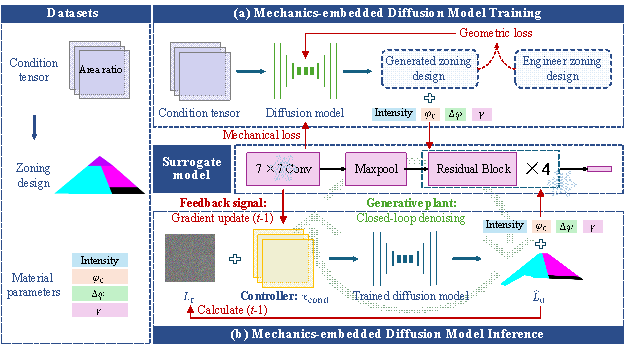
Figure 1 Mechanics-embedded diffusion with closed-loop denoising for intelligent zoning design of CFRDs
Here, intensity,  ,
,  , and
, and  denote the material parameters considered in this
study that influence anti-sliding stability.
denote the material parameters considered in this
study that influence anti-sliding stability.
Table 1 Symbolic representations of tensors
|
Description |
|
|
|
Primary rockfill zone tensor (2D). If the primary rockfill zone
is present at this location, the value of |
|
|
Secondary rockfill zone tensor (2D). If the secondary rockfill
zone is present at this location, the value of |
|
|
Drainage zone tensor (2D). If the drainage zone is present at
this location, the value of |
|
|
Modulus-increased zone tensor (2D). If the modulus-increased
zone is present at this location, the value of |
|
|
Zoning layout tensor (4D). |
|
|
Design condition tensor (4D). The tensor encodes the design conditions of the CFRD, including the normalized material volume parameters of each zone. |
|
|
Material parameter tensor (16D). The tensor encodes the material parameters of each CFRD zone, including intensity,
|
|
|
Mask tensor (2D). The tensor is the union of the four channels
of the |
|
|
Minimum safety factor for anti-sliding stability (1D). Downstream minimum safety factor for anti-sliding stability corresponding to a given CFRD zoning layout and material parameters. |
|
|
Surrogate model output tensor (1D). Downstream minimum safety factor for anti-sliding stability predicted by the surrogate model corresponding to a given CFRD zoning layout and material parameters. |
|
|
Minimum safety factor for anti-sliding stability specified by the code (1D). Downstream minimum safety factor for anti-sliding stability specified by the code for a given CFRD zoning layout and material parameters. |
|
|
Input tensor (4D) in time t, t=0, 1, 2,
3, …, T. Specifically, |
|
|
Predicted clean zoning layout tensor (4D) at the current denoising
timestep. It is reconstructed from the current noisy
input |





3 Dataset Construction
3.1 Feature-space–based Data Representation
This study proposes a feature-space–based data representation method for CFRD design, which integrates complex computer-aided design (CAD) drawings, design conditions, and rockfill material parameters into a unified representation. The resulting feature tensors serve as input and output data for the diffusion model and as input data for the mechanical surrogate model.
In this study, the CFRD design conditions
are defined as the material-volume ratios of the primary and secondary rockfill,
drainage zone, and modulus-increased zones to the total volume. The material
parameters include the internal friction angle  , variation
  , unit weight
  , and seismic intensity. Compared with the
RGB-based data-encoding approach in Liao et al. (2025) [25], the proposed
feature-space–based representation eliminates the semantic ambiguity inherent
in RGB encoding and offers greater feature compatibility, making it applicable
to various types of engineering drawings [22]. The following details the input
and output features of the diffusion and surrogate models. Tensor notations
are summarized in Table 1, and tensor-construction
methods are illustrated in Figure 2.
, and seismic intensity. Compared with the
RGB-based data-encoding approach in Liao et al. (2025) [25], the proposed
feature-space–based representation eliminates the semantic ambiguity inherent
in RGB encoding and offers greater feature compatibility, making it applicable
to various types of engineering drawings [22]. The following details the input
and output features of the diffusion and surrogate models. Tensor notations
are summarized in Table 1, and tensor-construction
methods are illustrated in Figure 2.
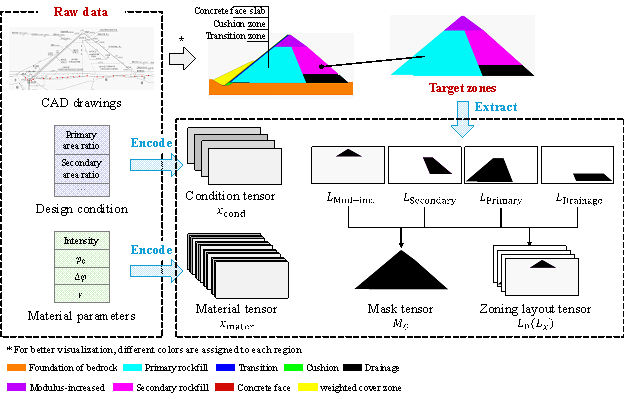
Figure 2 Method of feature-space–based data representation
(1) The inputs and condition tensors of the diffusion model are defined in Equations (1–4). The diffusion model requires no explicit output labels during training. Instead, the training process learns to reconstruct clean data from noisy inputs under the given condition tensors.
|
Input tensor: |
(1) |
|
|
(2) |
|
Condition tensor: |
(3) |
|
|
(4) |




where
 denotes the concatenation operator;
  represents the binary second-order feature tensor of each
zone, where
represents the binary second-order feature tensor of each
zone, where  (black) indicates that the element
  belongs to the corresponding zone, otherwise
  (white);
  is a vector composed
of the normalized design conditions of the four zones;
is a vector composed
of the normalized design conditions of the four zones;  denotes an all-one tensor; and
  represents the outer product, which expands and replicates
 to match the dimensions
  of the input channels.
In addition, as the dam section occupies only a local region within the overall tensor, external blank areas may dilute the features. To address this, a mask tensor is introduced to identify the effective region of the section and enhance the feature density:
|
|
(5) |

where
 denotes the union of tensors;
  if any zone channel has a value of 1 at a given point,
and
if any zone channel has a value of 1 at a given point,
and  only when all channels are 0.
(2) Inputs and outputs of the mechanical surrogate model
During training, to ensure that the surrogate
model can effectively serve as a mechanical constraint in intelligent design,
its inputs are defined as  , consistent with the outputs of the diffusion
model, and
, consistent with the outputs of the diffusion
model, and  . A random noise factor between 0.5 and 1.0
is introduced to accommodate the nonideal binary distributions of the diffusion
outputs (i.e., channel values not strictly equal to 1.0):
. A random noise factor between 0.5 and 1.0
is introduced to accommodate the nonideal binary distributions of the diffusion
outputs (i.e., channel values not strictly equal to 1.0):
|
Input tensor: |
(6) |
|
|
(7) |
|
|
(8) |



where
 is defined as the concatenation of four material parameter
tensors across all zones, forming a 16-dimensional tensor;
is defined as the concatenation of four material parameter
tensors across all zones, forming a 16-dimensional tensor;  denotes the vector
of four normalized material parameters for zone
denotes the vector
of four normalized material parameters for zone  ; and
; and  represents the
normalized value of the
represents the
normalized value of the  parameter in zone
  . Notably, if a specific zone is absent in
a sample, all four material channels corresponding to that zone are assigned
a value of -1 to maintain input dimensional consistency.
. Notably, if a specific zone is absent in
a sample, all four material channels corresponding to that zone are assigned
a value of -1 to maintain input dimensional consistency.
The target output of the surrogate model is
the downstream minimum anti-sliding stability safety factor (  ) corresponding to a given CFRD zoning layout and material
parameters (
) corresponding to a given CFRD zoning layout and material
parameters (  ):
):
|
Output tensor: |
(9) |

3.2 Dataset Construction for Surrogate Model
A total of 42 real-world CFRD design cases were collected for model training in this study. However, previous research has indicated that such a dataset is insufficient for effective deep-learning model training [15]. Therefore, based on the parameterized generation method for CFRD zoning layouts and material parameters proposed in earlier works [25, 31], this study performs data augmentation and generates synthetic parameterized samples to enhance the diversity and coverage of the dataset.
For zoning-layout
generation, key control parameters of CFRD cross-section designs were extracted
from real-world samples (Figure 3 (b))
and parameterized (Figure 3 (a)).
Based on empirical parameter ranges and computational formulas summarized
in previous studies [25], 300 synthetic CFRD sections were randomly generated
(Figure 3 (c)). Similarly, material parameters
such as  and
and
 were randomly sampled within
the empirical parameter ranges established in prior research [31], with up
to 3,000 sets generated for each section. By randomly combining the real-world
and parameterized CFRD layouts with 3,000 sets of material parameters, a dataset
of approximately one million samples was constructed.
This dataset was then split into training and validation sets at
a ratio of 9:1. This large-scale dataset enhanced the diversity of zoning configurations
and was used to train and validate the surrogate model across a broad range
of geometric and material conditions.
were randomly sampled within
the empirical parameter ranges established in prior research [31], with up
to 3,000 sets generated for each section. By randomly combining the real-world
and parameterized CFRD layouts with 3,000 sets of material parameters, a dataset
of approximately one million samples was constructed.
This dataset was then split into training and validation sets at
a ratio of 9:1. This large-scale dataset enhanced the diversity of zoning configurations
and was used to train and validate the surrogate model across a broad range
of geometric and material conditions.
For the final test, the dataset was constructed using only real-world CFRD geometries, because the surrogate model is ultimately intended to support practical engineering design. Specifically, 7 real-world CFRD cases were selected, and for each case, 1,000 sets of material parameters were randomly generated within the same empirical ranges, resulting in a total of 7,000 test samples. This setting enabled the evaluation to be conducted on real engineering layouts while still maintaining sufficient variability in material conditions.
Finally,
the simplified Bishop method was applied to each sample to compute the anti-sliding
stability safety factor, with  selected as the target output (
 ). The loading condition was uniformly
set to Exceptional Service Condition II,
representing the most unfavorable case combining the upstream dead-water level
and seismic load, in accordance with the Design Code for Rolled Earth-Rock
Fill Dams (SL 274-2020) [32].
). The loading condition was uniformly
set to Exceptional Service Condition II,
representing the most unfavorable case combining the upstream dead-water level
and seismic load, in accordance with the Design Code for Rolled Earth-Rock
Fill Dams (SL 274-2020) [32].
Given
that the geometry and loading conditions of CFRDs vary smoothly along the
dam axis, the overall structural response is primarily governed by the cross-sectional
direction. Therefore, two-dimensional section analysis can accurately and
conservatively represent the dam’s anti-sliding stability [33]. Moreover,
thin local components such as the concrete face slab and cushion zone have
limited influence on global stability. Accordingly, this study adopts the
major two-dimensional zoning layout (  ) and material parameters of each
zone (
) and material parameters of each
zone (  ) as model inputs, allowing the
surrogate model to reasonably learn their relationships with
) as model inputs, allowing the
surrogate model to reasonably learn their relationships with
 .
.
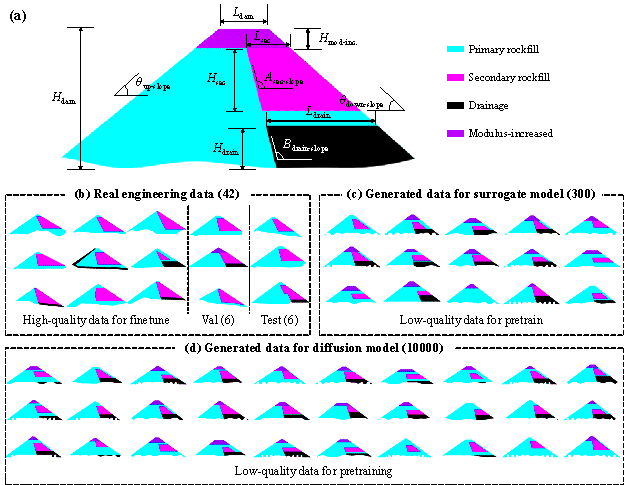
Figure 3 Representative samples of the CFRD zone design datasets
3.3 Dataset Construction for Diffusion Model
As discussed in Section
3.2, the limited number of real-world CFRD samples is insufficient
for effective diffusion model training. Therefore, the dataset was expanded
using the aforementioned parameterized section-generation method, yielding
10,000 CFRD sectional layouts as target outputs (  ) for the diffusion model. The design condition
tensor (
) for the diffusion model. The design condition
tensor (  ), which guides the denoising process, was
defined as the ratio of each zone’s area to the total section area, and was
equivalent to the rockfill material volume ratio. Finally, these generated
samples were combined with 42 real-world design cases to form the complete
training dataset for the diffusion model.
), which guides the denoising process, was
defined as the ratio of each zone’s area to the total section area, and was
equivalent to the rockfill material volume ratio. Finally, these generated
samples were combined with 42 real-world design cases to form the complete
training dataset for the diffusion model.
Notably, the parameterized dataset used for the diffusion model differed in scale from that for the surrogate model. The surrogate model also had to cover the material parameter space, and an excessive number of section samples would substantially increase the computational cost. Previous studies had shown that the current dataset size was sufficient to achieve high surrogate performance [31]. In contrast, the diffusion model’s learning of high-dimensional zoning design patterns relied more heavily on large-scale samples.
4 Surrogate Model for Evaluating Mechanics Performance
4.1 ResNet-based Surrogate Model
Given the strong nonlinear coupling between the CFRD zoning and material parameters, a deep network is required to capture multiscale features. Therefore, ResNet was adopted as the backbone of the surrogate model, as its residual connections alleviated gradient vanishing and degradation in deep networks, facilitating stable training at greater depths [34]. In addition, this study investigated the influence of different ResNet architectures on the predictive performance of the surrogate model. The model structure and dataset configuration are illustrated in Figure 4.
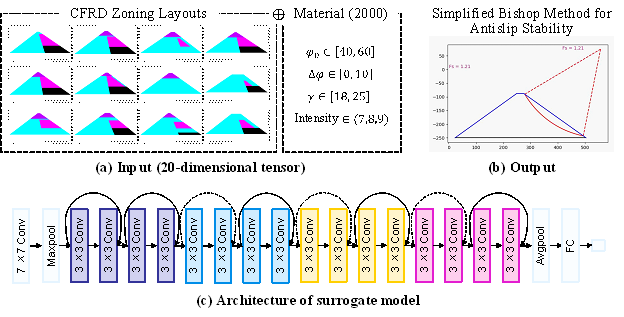
Figure 4 Datasets and architecture of the surrogate model
To enhance the model robustness and generalization,
the zoning layout  was randomly scaled and translated for data augmentation
during training. The Huber loss was adopted for its robustness to outliers,
reducing the influence of extreme samples on model convergence. The AdamW
optimizer was used with a weight decay of 0.01. The learning rate followed
a SequentialLR warm-up and CosineAnnealingWarmRestarts schedule, with a maximum
rate of
was randomly scaled and translated for data augmentation
during training. The Huber loss was adopted for its robustness to outliers,
reducing the influence of extreme samples on model convergence. The AdamW
optimizer was used with a weight decay of 0.01. The learning rate followed
a SequentialLR warm-up and CosineAnnealingWarmRestarts schedule, with a maximum
rate of  , warm-up step of 1000, and restart period
of 20 epochs. Training was conducted for 50 epochs using an early stopping
strategy.
, warm-up step of 1000, and restart period
of 20 epochs. Training was conducted for 50 epochs using an early stopping
strategy.
4.2 Two-stage Training Strategy for Surrogate Model
Although parameterized generation greatly expands the dataset size, its feature distribution still differs significantly from that of real-world data, while real-world samples account for only a small proportion of the total. Directly mixing the two during training would hinder the model’s ability to learn the true data distribution. Therefore, this study adopted a two-stage training strategy for the surrogate model to fully leverage the quantity advantage of generated data, while preserving its capacity to learn from real-world engineering data.
Specifically, the two-stage training strategy consisted of pretraining and fine-tuning phases. In the first stage, the surrogate model was pretrained solely on synthetic data, to learn the fundamental patterns of anti-sliding stability calculation. Once the loss converged, the model’s weight was saved. In the second stage, the model architecture and hyperparameters remained unchanged, and the pretrained weights were loaded for fine-tuning with real-world engineering data. This enabled the model to capture the statistical distributions and mechanical response characteristics of real-world cases, thereby improving its predictive accuracy in practical applications.
5 Mechanics-embedded Diffusion Framework
5.1 Architecture of the Diffusion Model
Recent studies have shown that diffusion models outperform GANs in terms of generation stability and quality [21]. A diffusion model adds noise to samples in the forward process and learns a probabilistic reverse mapping to gradually denoise and reconstruct target samples. Building on this framework, this study introduced a mask tensor to guide the model’s attention to key regions and a condition tensor to provide design constraints.
During training,  was progressively perturbed by Gaussian noise, and after
T iterations, there was no distinction between
was progressively perturbed by Gaussian noise, and after
T iterations, there was no distinction between  and pure Gaussian noise. Using the reparameterization trick
and additivity of independent Gaussian distributions,
and pure Gaussian noise. Using the reparameterization trick
and additivity of independent Gaussian distributions,  (t=0,
1, 2, 3, …, T)
could be obtained at any timestep. A mask tensor was introduced simultaneously
to enhance the feature density:
(t=0,
1, 2, 3, …, T)
could be obtained at any timestep. A mask tensor was introduced simultaneously
to enhance the feature density:
|
|
(10) |

where
 . Here,
  denotes the noise-variance schedule; a larger
  introduces greater noise, leading to more stochastic samples.
 represents a multivariate Gaussian distribution with zero
mean and identity covariance matrix.
represents a multivariate Gaussian distribution with zero
mean and identity covariance matrix.  is the mask tensor.
The diffusion model  adopts a U-Net architecture integrated with a self-attention
mechanism, as shown in Figure 5.
The model takes the noisy sample
adopts a U-Net architecture integrated with a self-attention
mechanism, as shown in Figure 5.
The model takes the noisy sample  as input and predicts the noise tensor
  conditioned on
  , thereby progressively reconstructing the
target sample
, thereby progressively reconstructing the
target sample  . The training objective is to minimize the
difference between the predicted and true noise:
. The training objective is to minimize the
difference between the predicted and true noise:
|
|
(11) |

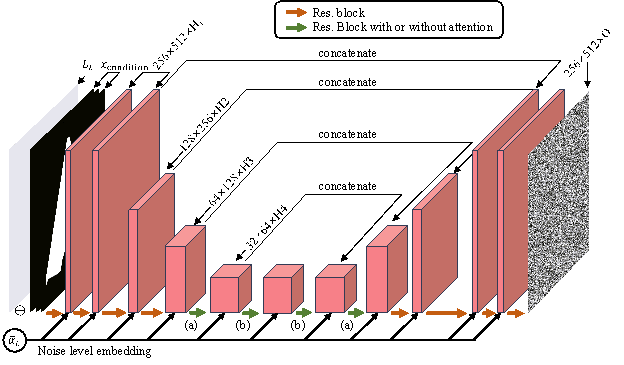
Figure 5 U-Net network architecture [21]
5.2 Mechanics-embedded Diffusion Framework Training Method
As discussed in
Section 4.2, considering that real-world data were limited but
high quality, while synthetic data were abundant but less accurate, this study adopted
a two-stage strategy for training the diffusion model. First, the model was
pretrained on 10,000 synthetic
 samples to learn the
fundamental zoning patterns. It was then fine-tuned using 42 real-world
samples to learn the
fundamental zoning patterns. It was then fine-tuned using 42 real-world  samples (with random scaling and translation for augmentation)
to align with engineers’ design practices and real-world design patterns.
During fine-tuning, mechanical constraints were introduced to further optimize
the mechanical compliance in line with the learned design regularities.
samples (with random scaling and translation for augmentation)
to align with engineers’ design practices and real-world design patterns.
During fine-tuning, mechanical constraints were introduced to further optimize
the mechanical compliance in line with the learned design regularities.
The loss function for the pretraining stage
is defined in Equation 11, while
that for the fine-tuning stage is presented in Equation
12. To ensure the mechanical compliance of the generated designs,
a mechanical penalty term derived from the surrogate model was incorporated
into the loss function. During diffusion model fine-tuning, the surrogate
model’s weights remained frozen and were used solely to predict the
 of each design, which in turn guided the weight updates
of the diffusion model. The fine-tuning workflow is illustrated in Figure 6.
of each design, which in turn guided the weight updates
of the diffusion model. The fine-tuning workflow is illustrated in Figure 6.
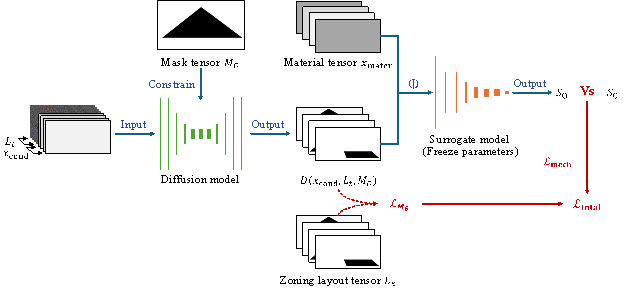
Figure 6 Mechanics-embedded training strategy for fine-tuning of diffusion model
|
|
(12) |

where  denotes the anti-sliding stability
loss computed by the surrogate model, and
denotes the anti-sliding stability
loss computed by the surrogate model, and
 is a weighting coefficient dynamically
adjusted during training to keep
is a weighting coefficient dynamically
adjusted during training to keep  and
and  at the same order of magnitude. Specifically,
to avoid unstable fluctuations caused by batch-level loss variations, exponential
moving averages of the diffusion and mechanical losses are first computed
as
at the same order of magnitude. Specifically,
to avoid unstable fluctuations caused by batch-level loss variations, exponential
moving averages of the diffusion and mechanical losses are first computed
as
|
|
(13) |
|
|
(14) |


where  denotes the training step and
  is the EMA smoothing coefficient. The target magnitude
of
is the EMA smoothing coefficient. The target magnitude
of  is then determined from the ratio between the two
smoothed loss terms:
is then determined from the ratio between the two
smoothed loss terms:
|
|
(15) |
|
|
(16) |


where  is used to avoid numerical instability. In this study,
 is checked every 20 training steps. To prevent frequent
oscillation, the coefficient is updated only when the order of magnitude of
is checked every 20 training steps. To prevent frequent
oscillation, the coefficient is updated only when the order of magnitude of
 differs from that of the current
  by at least one order. This order-of-magnitude-based
dynamic weighting strategy allows the mechanical loss to provide effective
guidance during fine-tuning while preventing it from dominating the original
diffusion denoising objective.
by at least one order. This order-of-magnitude-based
dynamic weighting strategy allows the mechanical loss to provide effective
guidance during fine-tuning while preventing it from dominating the original
diffusion denoising objective.
In the
actual experiments,  mainly varied between
 and
and
 . To evaluate its influence,
two fixed settings were compared with the proposed dynamic weighting strategy,
as shown in Table 2. The dynamic strategy achieved the highest
. To evaluate its influence,
two fixed settings were compared with the proposed dynamic weighting strategy,
as shown in Table 2. The dynamic strategy achieved the highest
 while maintaining a high
IoU, indicating that it improved mechanical safety without substantially reducing
similarity to engineer-designed layouts. In contrast, fixed weights led to
lower safety margins, and the larger fixed weight also caused a clear decrease
in IoU. These results demonstrate that dynamic adjustment of
while maintaining a high
IoU, indicating that it improved mechanical safety without substantially reducing
similarity to engineer-designed layouts. In contrast, fixed weights led to
lower safety margins, and the larger fixed weight also caused a clear decrease
in IoU. These results demonstrate that dynamic adjustment of
 better balances generative
accuracy and mechanical compliance.
better balances generative
accuracy and mechanical compliance.
Table 2 Sensitivity analysis of the weighting coefficient 
|
|
Dynamic adjustment |
|
|
|
0.857 |
0.923 |
0.931 |
|
|
FoSmin |
1.286 |
1.301 |
1.280 |


 represents the surrogate model’s
prediction;
represents the surrogate model’s
prediction;  and
and  are the mean and standard deviation, respectively, of the
prediction residuals; and
are the mean and standard deviation, respectively, of the
prediction residuals; and  is a conservative coefficient corresponding to a specified
confidence level. The residual
is a conservative coefficient corresponding to a specified
confidence level. The residual  refers to the prediction error of the surrogate model on
the validation set.
refers to the prediction error of the surrogate model on
the validation set.
Considering the inherent uncertainty in the
surrogate model’s predictions, this study applies a conservative calibration
to the predicted result  using the mean
  and standard deviation
  of the prediction residuals
  for validation datasets:
|
|
(17) |
|
|
(18) |
|
|
(19) |
|
|
(20) |




where
 denotes the inverse cumulative distribution function of
the standard normal distribution, and
denotes the inverse cumulative distribution function of
the standard normal distribution, and  represents the
confidence level. In this study,
represents the
confidence level. In this study,  , corresponding to
  , ensuring that the prediction residual of
the surrogate model does not exceed
, ensuring that the prediction residual of
the surrogate model does not exceed  , with 95% confidence.
During pretraining, the mean squared error
(MSE) was used as the loss function, with the Adam optimizer. The learning
rate followed a CosineAnnealingLR schedule, with a maximum value of
 and a scheduling period
of 50 epochs. The number of diffusion timesteps was set to 2000, and training
runs were performed for 1000 epochs with early stopping. During fine-tuning,
the maximum learning rate was reduced to
and a scheduling period
of 50 epochs. The number of diffusion timesteps was set to 2000, and training
runs were performed for 1000 epochs with early stopping. During fine-tuning,
the maximum learning rate was reduced to  with a scheduling period of 5000 epochs and a total of 20,000 training iterations, while other
hyperparameters remained the same as those in pretraining.
with a scheduling period of 5000 epochs and a total of 20,000 training iterations, while other
hyperparameters remained the same as those in pretraining.
5.3 Mechanics-embedded Diffusion Framework Inference Method
Mechanical constraints were incorporated through
the surrogate model during training, enabling the diffusion model to learn
the implicit relationship between design layouts and mechanical performance.
However, such training-stage embedding only provides static, distribution-level
guidance and cannot guarantee that each generated sample satisfies mechanical
constraints. Due to the stochastic and stepwise nature of diffusion denoising,
generated layouts may still drift beyond feasible regions during inference.
Moreover, under a given initial  , merely altering the zoning geometry could
be insufficient to meet code requirements or may lead to inefficient material
allocation. To address these limitations, mechanical constraints are further
embedded into the inference stage by explicitly modifying the denoising process of the diffusion model to incorporate closed-loop
feedback. Specifically, without updating network parameters, the surrogate
model evaluates the predicted layout at each denoising step and provides differentiable
feedback to iteratively update
, merely altering the zoning geometry could
be insufficient to meet code requirements or may lead to inefficient material
allocation. To address these limitations, mechanical constraints are further
embedded into the inference stage by explicitly modifying the denoising process of the diffusion model to incorporate closed-loop
feedback. Specifically, without updating network parameters, the surrogate
model evaluates the predicted layout at each denoising step and provides differentiable
feedback to iteratively update  . This modification enables dynamic, sample-specific
adjustment throughout the inference stage, progressively guiding each design
toward the feasible domain. As a result, the method
transforms diffusion sampling from an open-loop generative process into a
closed-loop, mechanics-embedded decision process, ensuring that the final
design simultaneously satisfies mechanical constraints and achieves improved
material efficiency.
. This modification enables dynamic, sample-specific
adjustment throughout the inference stage, progressively guiding each design
toward the feasible domain. As a result, the method
transforms diffusion sampling from an open-loop generative process into a
closed-loop, mechanics-embedded decision process, ensuring that the final
design simultaneously satisfies mechanical constraints and achieves improved
material efficiency.
Specifically, in standard diffusion inference,
the model progressively denoised the initial noisy sample  to obtain
  , as shown in Equation
21. At each timestep
, as shown in Equation
21. At each timestep  , the noisy section
  , corresponding
  , and current noise level
  were fed into the U-Net network to predict the noise tensor
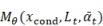 from which the denoised sample
  was computed.
|
|
(21) |

To incorporate mechanical constraints during
inference, the denoising process in Equation
21 was divided into two steps. First, the predicted clean zoning
layout was obtained using the current noisy sample  and model-predicted noise tensor
 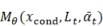 , as shown in Equation
22. Then, by adding the noise corresponding to the previous timestep,
as defined in Equation 23, the same
result as that in Equation 21 was
recovered.
, as shown in Equation
22. Then, by adding the noise corresponding to the previous timestep,
as defined in Equation 23, the same
result as that in Equation 21 was
recovered.
|
|
(22) |
|
|
(23) |


In this way, the predicted clean zoning layout
 could be obtained at each timestep without altering the
original denoising formulation. The mechanical loss was then computed based
on
could be obtained at each timestep without altering the
original denoising formulation. The mechanical loss was then computed based
on  to introduce the mechanical constraint, after which
  was restored to proceed with the next denoising step. Specifically,
during each generation step,
was restored to proceed with the next denoising step. Specifically,
during each generation step,  and the corresponding material parameters
  were fed into the trained surrogate model
  to evaluate the
deviation between the predicted
to evaluate the
deviation between the predicted  (
(  ) and code-specified limit
  . Before use, the surrogate prediction was
conservatively calibrated following the method described in Section 5.2, by adjusting
. Before use, the surrogate prediction was
conservatively calibrated following the method described in Section 5.2, by adjusting  as
as  , as shown in Equation
24.
, as shown in Equation
24.
|
|
(24) |

where
 is determined according to the Chinese design code SL 274-2020
(Ministry of Water Resources of the People’s Republic of China, 2020), as
listed in Table 3. In this study,
the values corresponding to the Exceptional Service Condition II (as described
in Section 3.2) were adopted for
different dam heights, ensuring that the generated CFRD designs yielded
is determined according to the Chinese design code SL 274-2020
(Ministry of Water Resources of the People’s Republic of China, 2020), as
listed in Table 3. In this study,
the values corresponding to the Exceptional Service Condition II (as described
in Section 3.2) were adopted for
different dam heights, ensuring that the generated CFRD designs yielded
 values as close as possible to, but not lower than, the
code-specified
values as close as possible to, but not lower than, the
code-specified  .
.
Table 3 Minimum safety factor for slope stability of dam [32]
|
Service condition |
Dam height (m) |
|||
|
> 100 |
50 - 100 |
30 - 50 |
< 30 |
|
|
1.20 |
1.15 |
1.15 |
1.10 |
|
Subsequently, the gradient of this loss with
respect to  was computed via backpropagation. With the parameters of
both the diffusion model and surrogate model kept frozen,
was computed via backpropagation. With the parameters of
both the diffusion model and surrogate model kept frozen,  was dynamically updated, as illustrated in Figure 7:
|
|
(25) |
|
|
(26) |


where
 denotes the learning rate. In this study, the Adam
optimizer with a CosineAnnealingLR schedule was used, with a maximum learning
rate of 0.01, a minimum of 5.0×10⁻⁶, and a scheduling period of
1000. Since the denoising process consists
of 2000 iterative timesteps,
denotes the learning rate. In this study, the Adam
optimizer with a CosineAnnealingLR schedule was used, with a maximum learning
rate of 0.01, a minimum of 5.0×10⁻⁶, and a scheduling period of
1000. Since the denoising process consists
of 2000 iterative timesteps,  is updated gradually over a large number of steps
rather than through a single abrupt correction. The use of a small and scheduled
learning rate limits the magnitude of each update, allowing the zoning proportions
to evolve smoothly during inference and reducing the risk of unstable or oscillatory
behavior.
is updated gradually over a large number of steps
rather than through a single abrupt correction. The use of a small and scheduled
learning rate limits the magnitude of each update, allowing the zoning proportions
to evolve smoothly during inference and reducing the risk of unstable or oscillatory
behavior.
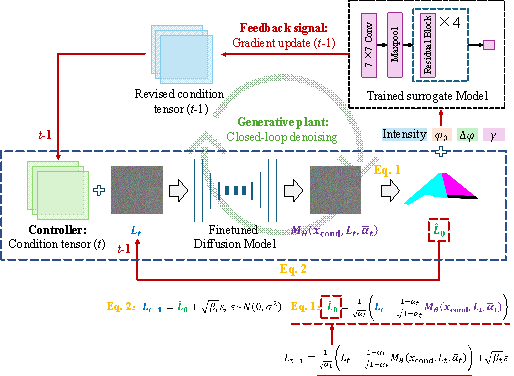
Figure 7 Closed-loop denoising process of CFRD-Mech-Diffusion, where the
mechanical deviation predicted by the surrogate model is fed back to iteratively
update  at each denoising step.
To ensure physical interpretability and feasibility of the design
variables, the intermediate condition vector is projected back onto the feasible
simplex via clipping and normalization. Specifically, let
 denote the condition vector after gradient update but before
constraint enforcement. The feasible condition vector is obtained as:
denote the condition vector after gradient update but before
constraint enforcement. The feasible condition vector is obtained as:
|
|
(27) |

where  is the number of zoning proportion variables, and
 is a small constant used to avoid numerical instability.
If the clipped sum is smaller than
is a small constant used to avoid numerical instability.
If the clipped sum is smaller than  , the previous feasible condition vector is retained. In practice,
this fallback case was not observed in our experiments, because
, the previous feasible condition vector is retained. In practice,
this fallback case was not observed in our experiments, because
 was initialized as a feasible proportion vector and updated
gradually using a scheduled small learning rate. This safeguard was included
to ensure numerical robustness and reproducibility during inference. For
a representative CFRD case, the evolution of
was initialized as a feasible proportion vector and updated
gradually using a scheduled small learning rate. This safeguard was included
to ensure numerical robustness and reproducibility during inference. For
a representative CFRD case, the evolution of  during closed-loop denoising is shown in Figure
8, where the condition variables change smoothly and gradually stabilize.
during closed-loop denoising is shown in Figure
8, where the condition variables change smoothly and gradually stabilize.
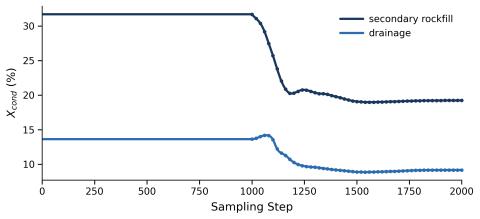
Figure 8 Evolution of
 during closed-loop denoising
It should be noted that the formulation of  differs between the training and inference stages. During
training, the loss is defined under fixed
differs between the training and inference stages. During
training, the loss is defined under fixed  to guide the model toward generating mechanically safer
designs for given conditions, thereby learning safety-aware generative priors.
In contrast, during inference, the model is assumed to already produce near-optimal
layouts under each condition, and
to guide the model toward generating mechanically safer
designs for given conditions, thereby learning safety-aware generative priors.
In contrast, during inference, the model is assumed to already produce near-optimal
layouts under each condition, and  is computed based on the deviation between the predicted
mechanical performance and code-specified limit
is computed based on the deviation between the predicted
mechanical performance and code-specified limit  . This loss is then used to iteratively adjust
 , driving the design toward code-compliant
solutions while avoiding overly conservative configurations and improving
economic efficiency.
, driving the design toward code-compliant
solutions while avoiding overly conservative configurations and improving
economic efficiency.
Through this process, CFRD-Mech-Diffusion
enables closed-loop, mechanics-embedded control during the denoising process
by dynamically adjusting the design direction based on real-time mechanical
feedback. For example, when the predicted  of
of  at a given timestep
  falls below the
code requirement, the backpropagated gradient update of
falls below the
code requirement, the backpropagated gradient update of  drives the model to reduce the shares of the secondary
rockfill and drainage zones while increasing those of primary rockfill and
modulus-increased zones. As a result, the method performs instance-level correction
for each sampled design, progressively guiding the solution back into the
feasible domain and enhancing overall structural stability.
drives the model to reduce the shares of the secondary
rockfill and drainage zones while increasing those of primary rockfill and
modulus-increased zones. As a result, the method performs instance-level correction
for each sampled design, progressively guiding the solution back into the
feasible domain and enhancing overall structural stability.
Given that the model’s predictions at early
timesteps contained substantial noise and the corresponding  features were still unstable, the predicted
  could not accurately
reflect the true mechanical state. Based on the observation and analysis of
results across timesteps, this study embedded the mechanical constraint starting
from step 1000, when the generated layout became well-formed with clearly
defined boundaries.
could not accurately
reflect the true mechanical state. Based on the observation and analysis of
results across timesteps, this study embedded the mechanical constraint starting
from step 1000, when the generated layout became well-formed with clearly
defined boundaries.
6 Analysis and Discussion of the Performance of Models
6.1 Training Details
To evaluate the effects of the proposed method and influencing factors on the model performance, two groups of ablation experiments were conducted, as summarized in Tables 4 and 5. Table 4 investigates the impact of different ResNet architectures and training strategies, while Table 5 examines the effects of data-representation methods, training strategies, and embedding stage of mechanical constraints on the generative performance of the diffusion model.
It should be noted that mixed training refers to sampling an equal number of real-world and synthetic data in each batch to maintain data balance, serving as a comparison with the two-stage training strategy. To ensure reproducibility, all experiments were conducted with a random seed of 42. The computational environment was configured as follows: OS: Ubuntu 22.04 LTS; CPU: Intel Xeon E5-2682 v4@64×3 GHz; RAM: 32 GB; GPU: NVIDIA GeForce RTX 3090 (24 GB).
Table 4 Comparison among different ResNet surrogate models and training strategy
|
ResNet-18 |
ResNet-34 |
ResNet-101 |
Mixed training |
Two-stage training |
|
|
S-M-101 |
√ |
√ |
|||
|
S-M-34 |
√ |
√ |
|||
|
S-M-18 |
√ |
√ |
|||
|
S-T-18 |
√ |
√ |
Table 5 Comparison of data representation and training-inference methods for the diffusion model
|
RGB representation |
Feature space representation |
Mixed training |
Two-stage training |
Mechanics-embedded training |
Mechanics-embedded inference |
|
|
R-M-N-N |
√ |
√ |
||||
|
R-T-N-N |
√ |
√ |
||||
|
F-T-N-N |
√ |
√ |
||||
|
F-T-T-N |
√ |
√ |
√ |
|||
|
F-T-N-I |
√ |
√ |
√ |
|||
|
F-T-T-I (CFRD-Mech-Diffusion) |
√ |
√ |
√ |
√ |
6.2 Evaluation Metrics
6.2.1 Intelligent Evaluation Method for Surrogate Models
In this study, to evaluate the performance
of the surrogate model in predicting  , three metrics were adopted: the coefficient
of determination (
, three metrics were adopted: the coefficient
of determination (  ), mean absolute error (MAE), and root mean
square error (RMSE):
), mean absolute error (MAE), and root mean
square error (RMSE):
|
|
(28) |
|
|
(29) |
|
|
(30) |



 measures the consistency and trend fitting between predicted
and actual values; MAE quantifies the average absolute deviation, reflecting
the overall prediction bias; and RMSE, being more sensitive to large errors,
effectively indicates the model’s robustness against extreme samples.
measures the consistency and trend fitting between predicted
and actual values; MAE quantifies the average absolute deviation, reflecting
the overall prediction bias; and RMSE, being more sensitive to large errors,
effectively indicates the model’s robustness against extreme samples.
6.2.2 Intelligent Evaluation Method for Designs Generated by the Diffusion Model
|
|
(31) |
|
|
(32) |


where,  and
and
 denote the
pixel sets of the
denote the
pixel sets of the  -th zone in the generated and engineer-designed
layouts, respectively.
-th zone in the generated and engineer-designed
layouts, respectively.
 denotes the weight assigned to the
 -th evaluated zone. In this study, equal weights were assigned
to the three evaluated zones. However, when the proposed method is extended
to other engineering design tasks, the weights can be flexibly adjusted.
-th evaluated zone. In this study, equal weights were assigned
to the three evaluated zones. However, when the proposed method is extended
to other engineering design tasks, the weights can be flexibly adjusted.
Besides, according to engineering experience, the unit cost of CFRD zones generally decreases in the following order: modulus-increased zones, primary rockfill, secondary rockfill, and drainage zones. Therefore, the material proportions of each zone were used as evaluation metrics to reflect the economic efficiency of the generated designs.
6.3 Analysis and Discussion
6.3.1 Comparison Results of Different ResNet Surrogate Models
Using the surrogate-model evaluation method described in Section 6.2.1, the ablation experiments defined in Table 4 were evaluated on real engineering test cases, and the results are presented in Table 6.
Table 6 Results among different ResNet surrogate models and training strategy
|
|
MAE |
RMSE |
|
|
S-M-101 |
0.6862 |
0.1272 |
0.1428 |
|
S-M-34 |
0.6961 |
0.1273 |
0.1411 |
|
S-M-18 |
0.7692 |
0.1348 |
0.1496 |
|
S-T-18 |
0.8400 |
0.0173 |
0.0204 |

The experimental results showed that the ResNet-18 surrogate model trained with the two-stage training strategy achieved the best performance across all evaluation metrics, demonstrating superior prediction accuracy and stability. Therefore, this model was adopted as the embedded mechanical constraint surrogate for the subsequent diffusion model training and inference stages.
Meanwhile, to conservatively calibrate the
predicted  when embedding mechanical constraints, the statistical
characteristics of the surrogate model were computed from the validation samples
using Equations 17–20, yielding
when embedding mechanical constraints, the statistical
characteristics of the surrogate model were computed from the validation samples
using Equations 17–20, yielding  and
and  . Notably, the small prediction bias of the
surrogate model on the validation set indicated high accuracy and stability
in predicting
. Notably, the small prediction bias of the
surrogate model on the validation set indicated high accuracy and stability
in predicting  , ensuring that no significant systematic
error was introduced during the diffusion model’s training and inference.
, ensuring that no significant systematic
error was introduced during the diffusion model’s training and inference.
6.3.2 Comparison Results of Data Representation, Training, and Inference Methods for the Diffusion Model
Using the diffusion model evaluation method described in Section 6.2.2, the ablation experiments defined in Table 5 were evaluated, and the results are presented in Table 7.
Table 7 Results of data representation and training-inference methods for the diffusion model
|
Max IoU |
Min IoU |
Mean IoU |
Std IoU |
Median IoU |
|
|
R-M-N-N |
0.7944 |
0.4497 |
0.5875 |
0.1290 |
0.5799 |
|
R-T-N-N |
0.9547 |
0.6557 |
0.7898 |
0.1537 |
0.7947 |
|
F-T-N-N |
0.9811 |
0.806 |
0.9405 |
0.0680 |
0.9686 |
|
F-T-T-N |
0.9752 |
0.7755 |
0.9232 |
0.0743 |
0.9454 |
|
F-T-N-I |
0.9611 |
0.7203 |
0.9024 |
0.0959 |
0.9516 |
|
F-T-T-I |
0.9815 |
0.7203 |
0.9032 |
0.0963 |
0.9447 |
(1) Comparison of Training Methods for the Diffusion Model
The results of the R-M-N-N and R-T-N-N experiments showed that the proposed two-stage training strategy significantly outperformed mixed training across all IoU metrics, with the mean IoU improving from 0.5875 to 0.7898. This demonstrated that the strategy effectively mitigated the learning bias caused by distribution differences between real-world and synthetic data. Therefore, the two-stage training strategy was adopted as the standard training approach for the diffusion model in subsequent experiments.
(2) Comparison of Data Representation Methods for the Diffusion Model
A comparison between R-T-N-N and F-T-N-N showed that the feature-space–based data representation method markedly improved the generative performance over the traditional RGB-based approach, with the mean IoU increasing from 0.7898 to 0.9405 and standard deviation decreasing from 0.1537 to 0.0680. This result indicated that the feature-space–based representation captured the semantic boundary relationships among different zones more accurately than RGB encoding. Therefore, the feature-space–based data representation method was adopted as the standard data representation approach in the subsequent experiments.
(3) Necessity of Mechanics Embedding during Training and Inference
To better illustrate the impact of mechanical
constraints on the diffusion model, the  values and material-allocation
changes of the generated designs were evaluated using real engineering cases
from the test dataset, as shown in Table 8.
values and material-allocation
changes of the generated designs were evaluated using real engineering cases
from the test dataset, as shown in Table 8.
Table 8 FoSmin and material usage ratios of each zone in the test set



























 FoSmin
= 1.2147
FoSmin
= 1.2147 FoSmin
= 1.2136
FoSmin
= 1.2136where
the code-specified  values for Test
2 and Test 5 were 1.15, and 1.2 for all others.
values for Test
2 and Test 5 were 1.15, and 1.2 for all others.  ,
,  ,
,  , and
, and  denote the percentage increases in material usage for the
primary rockfill, secondary rockfill, drainage, and modulus-increased zones,
respectively, relative to that of F-T-N-N.
denote the percentage increases in material usage for the
primary rockfill, secondary rockfill, drainage, and modulus-increased zones,
respectively, relative to that of F-T-N-N.
As shown in Table 7, although incorporating mechanical constraints during training and inference leads to a slight decrease in IoU, the overall generative accuracy remains largely unaffected. This indicates that the introduction of mechanical constraints does not compromise the diffusion model’s generative stability.
Furthermore, incorporating mechanical constraints
yields a significant improvement in mechanical compliance, as shown in Table
8. Specifically, a comparison between F-T-N-N
and F-T-T-N indicates that embedding mechanical loss
during training enables the model, under a given  , to generate designs with higher
 . This demonstrates that the model has learned
safety-aware priors, biasing the distribution of generated layouts toward
mechanically safer configurations and providing a favorable foundation and
gradient direction for the subsequent mechanical correction during inference.
. This demonstrates that the model has learned
safety-aware priors, biasing the distribution of generated layouts toward
mechanically safer configurations and providing a favorable foundation and
gradient direction for the subsequent mechanical correction during inference.
Meanwhile, the comparison between F-T-N-I and F-T-N-N
shows that embedding mechanical feedback during the denoising process enables
the model to adjust individual designs in response to mechanical deviations,
guiding generated layouts toward satisfying mechanical constraints while improving
material allocation. However, the improvement in economic efficiency remains
limited. This is because, without mechanical constraints introduced during
training, the model does not learn safety-aware generative priors. As a result,
the initial generation trajectory may deviate from optimal configurations,
and the subsequent feedback-based adjustment of  mainly serves to enforce feasibility rather than to explore
globally optimal layouts. Consequently, although mechanical compliance can
be achieved through stepwise correction, the overall design may still fall
short of optimal material allocation.
mainly serves to enforce feasibility rather than to explore
globally optimal layouts. Consequently, although mechanical compliance can
be achieved through stepwise correction, the overall design may still fall
short of optimal material allocation.
In contrast, comparing F-T-T-N, F-T-N-I,
and F-T-T-I (CFRD-Mech-Diffusion)
demonstrates that combining both mechanisms leads to the best performance,
indicating that training-stage embedding and inference-stage
feedback are complementary. The former shapes safety-aware priors at the distribution
level, while the latter performs instance-level control during inference.
As a result, the model achieves optimal material allocation and the lowest
construction cost while satisfying code requirements. Even when the initial
 leads to material redundancy, the model can adaptively
adjust the zoning-area ratios during inference, ultimately ensuring mechanical
compliance, while substantially improving the design’s economic efficiency.
Specifically, relative to F-T-N-N,
the proportions of low-cost zones (secondary rockfill and drainage zones)
increase by 16.56% and 3.51%, whereas those of high-cost zones (primary rockfill
and modulus-increased zones) decrease by 10.17% and 4.87%, respectively.
leads to material redundancy, the model can adaptively
adjust the zoning-area ratios during inference, ultimately ensuring mechanical
compliance, while substantially improving the design’s economic efficiency.
Specifically, relative to F-T-N-N,
the proportions of low-cost zones (secondary rockfill and drainage zones)
increase by 16.56% and 3.51%, whereas those of high-cost zones (primary rockfill
and modulus-increased zones) decrease by 10.17% and 4.87%, respectively.
The fine-tuning and inference times of F-T-N-N and F-T-T-I (CFRD-Mech-Diffusion) are listed in Table 9. The results indicate that CFRD-Mech-Diffusion does not significantly increase training or inference overhead; yet it consistently satisfies code requirements, such as anti-sliding stability, and achieves greater economic efficiency through optimized material allocation.
Table 9 The fine-tuning and inference times of F-T-N-N and F-T-T-I
|
Fine-tuning |
Inference / case |
|
|
F-T-N-N |
12h 25m |
3m 15s |
|
F-T-T-I (CFRD-Mech-Diffusion) |
14h 54m |
4m 41s |
7 Case Study
7.1 Basic Information of the Case
A case study was conducted on a CFRD in China, with a seismic fortification intensity of VII and a designed horizontal peak ground acceleration of 105 cm/s2. The dam material consisted mainly of calcareous–siliceous slate with local breccia. The dam height was 122.4 m, and the mechanical parameters of each zone are listed in Table 10.
Table 10 Mechanical parameters of each zone
|
Primary rockfill |
Secondary rockfill |
Drainage |
|
|
Intensity |
7 |
7 |
7 |
|
|
45.6 |
40.9 |
38 |
|
|
11 |
10.4 |
10.1 |
|
|
22 |
22 |
22 |


Based on expert knowledge and engineering analysis, considering material sources, mechanical parameters, and dam height, the preliminary area ratios for the secondary rockfill and drainage zones were determined to be 46.88% and 10.54%, respectively, with no modulus-increased zone included. Under these conditions, the proposed CFRD-Mech-Diffusion method was applied to the zoning layout design, while a diffusion model without mechanical constraints (F-T-N-N) served as the control group to validate the proposed method’s advantages in terms of the generative accuracy and mechanical compliance.
7.2 Case Analysis Result
The CFRD zoning layouts
generated by the two methods, along with their corresponding
 values, are presented
in Figure 9. According to SL 274-2020,
the project was classified as a Grade I rockfill dam, for which the code-specified
minimum
values, are presented
in Figure 9. According to SL 274-2020,
the project was classified as a Grade I rockfill dam, for which the code-specified
minimum  was 1.2.
|
FoSmin = 1.166 (a) Diffusion model (F-T-N-N) |
FoSmin = 1.206 (b) CFRD-Mech-Diffusion |


Figure 9 Design results of the case study
The results showed that the conventional diffusion
model failed to meet the code-specified minimum  of 1.2, when
generating designs based on the initial zoning ratios, leading to potential
sliding risks and insufficient overall structural safety. This indicated that
using engineer-defined
of 1.2, when
generating designs based on the initial zoning ratios, leading to potential
sliding risks and insufficient overall structural safety. This indicated that
using engineer-defined  alone was inadequate to satisfy the anti-sliding stability
requirements and that further adjustment of the zoning ratios was necessary.
Moreover, geometric statistical learning alone cannot guarantee mechanical
compliance. This limitation stems from the training objective of conventional
diffusion models, which minimizes noise prediction error (Equation 11), driving the model to reproduce
historical geometric patterns without considering mechanical parameters or
explicitly penalizing mechanically infeasible configurations. In CFRD design,
even if a generated layout appeared geometrically similar to historical cases,
changes in key mechanical indicators could significantly affect the anti-sliding
stability margin; thus, geometric optimality did not necessarily imply mechanical
feasibility.
alone was inadequate to satisfy the anti-sliding stability
requirements and that further adjustment of the zoning ratios was necessary.
Moreover, geometric statistical learning alone cannot guarantee mechanical
compliance. This limitation stems from the training objective of conventional
diffusion models, which minimizes noise prediction error (Equation 11), driving the model to reproduce
historical geometric patterns without considering mechanical parameters or
explicitly penalizing mechanically infeasible configurations. In CFRD design,
even if a generated layout appeared geometrically similar to historical cases,
changes in key mechanical indicators could significantly affect the anti-sliding
stability margin; thus, geometric optimality did not necessarily imply mechanical
feasibility.
In contrast, the proposed CFRD-Mech-Diffusion
could stably generate zoning layouts that met code requirements. As described
in Section 6.3.2, this was achieved
through two key mechanisms: (1) during training, a mechanical penalty term
was embedded to guide the model toward safer designs under the same
 , thereby shaping safety-aware priors at the
distribution level; and (2) during inference, the surrogate model continuously
evaluated the stability of the generated layout throughout denoising, enabling
instance-level, closed-loop correction. Specifically, when the predicted
, thereby shaping safety-aware priors at the
distribution level; and (2) during inference, the surrogate model continuously
evaluated the stability of the generated layout throughout denoising, enabling
instance-level, closed-loop correction. Specifically, when the predicted
 fell below the
code threshold, the gradient automatically adjusted
fell below the
code threshold, the gradient automatically adjusted  to optimize the zoning ratios. This process typically reduces
the proportions of the secondary rockfill and drainage zones while reallocating
material to structurally stronger regions, thereby improving overall stability.
As a result, even when the initial
to optimize the zoning ratios. This process typically reduces
the proportions of the secondary rockfill and drainage zones while reallocating
material to structurally stronger regions, thereby improving overall stability.
As a result, even when the initial  leads to infeasible designs, the model can progressively
correct them during inference and ultimately produce code-compliant solutions.
leads to infeasible designs, the model can progressively
correct them during inference and ultimately produce code-compliant solutions.
8 Conclusion
To address the lack of mechanical compliance in current generative design methods, this study proposes a mechanics-embedded diffusion framework that incorporates mechanical constraints into training via the loss function, and, more importantly, embeds mechanical feedback into the inference stage by modifying the denoising process (CFRD-Mech-Diffusion). Validated through complex infrastructure zoning tasks (specifically CFRDs), the proposed method significantly improves mechanical compliance and material efficiency while maintaining high generative accuracy, thereby supporting safety-aware automation in construction design. The key findings are as follows:
(1) A mechanics-embedded diffusion framework
was developed for both training and inference to facilitate safe and economic
design generation. During training, a differentiable mechanical loss guided
the model toward designs with a higher  under a given
 , enabling it to learn safety-aware and near-optimal
design patterns. During inference, model parameters
remained fixed, while gradients were propagated to update
, enabling it to learn safety-aware and near-optimal
design patterns. During inference, model parameters
remained fixed, while gradients were propagated to update  based on mechanical deviations, effectively embedding mechanical
feedback by modifying the denoising process. Built
on the priors learned during training, such updates continue to produce near-optimal
layouts rather than merely feasible ones. The two stages are thus tightly
coupled: training captured mechanical regularities, while inference provided
adaptive and stepwise control. This allows the model to autonomously refine
designs to meet safety standards without manual iteration. Experimental results
showed that incorporating mechanical constraints in both stages neither significantly
reduced generative accuracy nor significantly increased computational cost;
nevertheless, the incorporation enabled the model to satisfy code requirements
while achieving superior material allocation and economic efficiency.
based on mechanical deviations, effectively embedding mechanical
feedback by modifying the denoising process. Built
on the priors learned during training, such updates continue to produce near-optimal
layouts rather than merely feasible ones. The two stages are thus tightly
coupled: training captured mechanical regularities, while inference provided
adaptive and stepwise control. This allows the model to autonomously refine
designs to meet safety standards without manual iteration. Experimental results
showed that incorporating mechanical constraints in both stages neither significantly
reduced generative accuracy nor significantly increased computational cost;
nevertheless, the incorporation enabled the model to satisfy code requirements
while achieving superior material allocation and economic efficiency.
(2) A feature-space–based data representation method was proposed to enhance AI learning efficiency. Experimental results showed that, compared to traditional RGB-based representations, this method improved generative accuracy (Mean IoU increased by 19.1%) and stability (standard deviation is decreased by 55.8%), demonstrating that abstract feature representations are more suitable for engineering design generation.
(3) A surrogate model based on the ResNet
architecture and two-stage training strategy was developed to support real-time
mechanical feedback. A systematic comparison
of different ResNet variants and training strategies was conducted. The results
showed that the ResNet-18 model trained with the two-stage strategy performed
best, achieving  ,
,  , and
, and  , providing accurate and stable mechanical
support for the subsequent diffusion model optimization.
, providing accurate and stable mechanical
support for the subsequent diffusion model optimization.
(4) Validation on CFRD zoning design scenarios
showed that when the initially selected  was suboptimal, the conventional diffusion model failed
to meet safety requirements. In contrast, the proposed method, leveraging
mechanical loss during training and dynamic feedback
during inference, consistently generated designs that satisfied mechanical
constraints, while achieving both safety and economic efficiency. This capability
reduces reliance on manual tuning and expert intervention, which is critical
for scalable and repeatable automation in construction design practice.
was suboptimal, the conventional diffusion model failed
to meet safety requirements. In contrast, the proposed method, leveraging
mechanical loss during training and dynamic feedback
during inference, consistently generated designs that satisfied mechanical
constraints, while achieving both safety and economic efficiency. This capability
reduces reliance on manual tuning and expert intervention, which is critical
for scalable and repeatable automation in construction design practice.
This study validated
the proposed method using the downstream
 as an example. Future
work will incorporate additional mechanical constraints,
such as deformation control and seepage stability, and explore multi-objective
mechanical compliance optimization, thereby further enhancing the safety,
serviceability, and durability of the generated designs. In addition, the dataset will be expanded by collecting additional real-world
engineering cases with diverse project characteristics, to more comprehensively
evaluate and improve the generalization capability of the proposed framework.
Importantly, while this study is presented in the context of intelligent design
for CFRDs, the proposed mechanics-embedded generative framework is not domain-specific
and can be readily extended to the intelligent design of other building and
infrastructure types where geometry, physical performance, and decision constraints
must be jointly considered.
as an example. Future
work will incorporate additional mechanical constraints,
such as deformation control and seepage stability, and explore multi-objective
mechanical compliance optimization, thereby further enhancing the safety,
serviceability, and durability of the generated designs. In addition, the dataset will be expanded by collecting additional real-world
engineering cases with diverse project characteristics, to more comprehensively
evaluate and improve the generalization capability of the proposed framework.
Importantly, while this study is presented in the context of intelligent design
for CFRDs, the proposed mechanics-embedded generative framework is not domain-specific
and can be readily extended to the intelligent design of other building and
infrastructure types where geometry, physical performance, and decision constraints
must be jointly considered.
Acknowledgment
This work is supported by the Key Science and Technology Project of POWERCHINA Ltd (DJ-ZDXM-2024-45), the National Natural Science Foundation of China (52408348), and the Beijing Municipal Natural Science Foundation (8252008). The authors also thank Mr. Yiding Liu (School of Civil Engineering, North China University of Technology) for his contributions to the research on the mechanics surrogate model.
References
[1] Ma H, Chi F. Major technologies for safe construction of high earth-rockfill dams. Engineering. 2016;2(4):498–509. https://doi.org/10.1016/j.eng.2016.04.001.
[2] Gu H, Fu X, Zhu Y, Chen Y, Huang L. Analysis of social and environmental impact of earth-rock dam breaks based on a fuzzy comprehensive evaluation method. Sustainability. 2020;12(15):6239. https://doi.org/10.3390/su12156239.
[3] Peng M, Gan L, Zhong Q, Yang G, Deng G, Cao Z, et al. Time-dependent system reliability analysis of a high concrete-faced rockfill dam by integrating multi-source monitoring information. Reliability Engineering & System Safety. 2025;262:111251. https://doi.org/10.1016/j.ress.2025.111251.
[4] Fan Q, Zhou S, Yang N. Optimization design of foundation excavation for Xiluodu super-high arch dam in China. Journal of Rock Mechanics and Geotechnical Engineering. 2015;7(2):120–135. https://doi.org/10.1016/j.jrmge.2015.03.001.
[5] Monedero J. Parametric design: A review and some experiences. Automation in Construction. 2000;9(4):369–377. https://doi.org/10.1016/S0926-5805(99)00020-5.
[6] Naderi S, Shabanlou S, Javaheri-Tafti MR, Yaghoubi B. Optimal design of diversion dams based on upgraded multi-objective particle swarm optimization (UMOPSO). International Journal of Construction Management. 2025;25(8):876–886. https://doi.org/10.1080/15623599.2024.2374113.
[7] Meng R, Cheong KH, Bao W, Wong KKL, Wang L, Xie N. Multi-objective optimization of an arch dam shape under static loads using an evolutionary game method. Engineering Optimization. 2018;50(6):1061–1077. https://doi.org/10.1080/0305215X.2017.1378876.
[8] Abdollahi A, Amini A, Hariri-Ardebili MA. An uncertainty-aware dynamic shape optimization framework: Gravity dam design. Reliability Engineering & System Safety. 2022;222:108402. https://doi.org/10.1016/j.ress.2022.108402.
[9] Qi G. Optimized program design of gravity dam section. Procedia Engineering. 2012;28:419–423. https://doi.org/10.1016/j.proeng.2012.01.743.
[10] Abbasi S, Seifollahi M, Farzaneh S, Süme V, Sadraei N, Abraham J, et al. Design optimization of concrete gravity dams using grasshopper optimization algorithm. Innovative Infrastructure Solutions. 2024;9(12):453. https://doi.org/10.1007/s41062-024-01741-w.
[11] Hariri-Ardebili MA, Pourkamali-Anaraki F. An automated machine learning engine with inverse analysis for seismic design of dams. Water. 2022;14(23):3898. https://doi.org/10.3390/w14233898.
[12] Saber Mahani A, Shojaee S, Salajegheh E, Khatibinia M. Hybridizing two-stage meta-heuristic optimization model with weighted least squares support vector machine for optimal shape of double-arch dams. Applied Soft Computing. 2015;27:205–218. https://doi.org/10.1016/j.asoc.2014.11.014.
[13] Liu R, Ma G, Kong F, Ai Z, Xiong K, Zhou W, et al. A surrogate-assisted intelligent design framework for arch dam shape multi-objective optimization. SSRN preprint. 2024. https://doi.org/10.2139/ssrn.4720928.
[14] Xiong R, Netser Y, Tang P, Li B, Hwang J. Socio-technical assessment of generative AI integration in architecture, engineering, and construction (AEC) workflows: An empirical study using O*NET occupational taxonomy. Advanced Engineering Informatics. 2026;71:104392. https://doi.org/10.1016/j.aei.2026.104392.
[15] Liao W, Lu X, Fei Y, Gu Y, Huang Y. Generative AI design for building structures. Automation in Construction. 2024;157:105187. https://doi.org/10.1016/j.autcon.2023.105187.
[16] Kingma DP, Welling M. Auto-encoding variational Bayes. arXiv preprint arXiv:1312.6114. 2013. https://doi.org/10.48550/arXiv.1312.6114. (arXiv)
[17] Isola P, Zhu J-Y, Zhou T, Efros AA. Image-to-image translation with conditional adversarial networks. In: Proceedings of the IEEE Conference on Computer Vision and Pattern Recognition (CVPR); 2017. p. 1125–1134. https://doi.org/10.1109/CVPR.2017.632.
[18] Han Y, Du W, Wang Q, Xue H, Gao B, Dong S. Generation of innovative structural connection components using generative adversarial networks. Advanced Engineering Informatics. 2025;68:103608. https://doi.org/10.1016/j.aei.2025.103608.
[19] Ho J, Jain A, Abbeel P. Denoising diffusion probabilistic models. Advances in Neural Information Processing Systems. 2020;33:6840–6851.
[20] Kong L, An Y. Multi-control stable diffusion model for automated generation of structural surface damage images in complex civil infrastructure. Advanced Engineering Informatics. 2026;73:104546. https://doi.org/10.1016/j.aei.2026.104546.
[21] Gu Y, Huang Y, Liao W, Lu X. Intelligent design of shear wall layout based on diffusion models. Computer-Aided Civil and Infrastructure Engineering. 2024;39(23):3610–3625. https://doi.org/10.1111/mice.13236.
[22] Han J, Lu X, Gu Y, Liao W, Cai Q, Xue H. Optimized data representation and understanding method for the intelligent design of shear wall structures. Engineering Structures. 2024;315:118500. https://doi.org/10.1016/j.engstruct.2024.118500.
[23] Qin S, Liao W, Huang Y, Zhang S, Gu Y, Han J, et al. Intelligent design for component size generation in reinforced concrete frame structures using heterogeneous graph neural networks. Automation in Construction. 2025;171:105967. https://doi.org/10.1016/j.autcon.2025.105967.
[24] Fei Y, Lu X, Liao W, Guan H. Data enhancement for generative AI design of shear wall structures incorporating structural optimization and diffusion models. Advances in Structural Engineering. 2025;13694332251353614. https://doi.org/10.1177/13694332251353614.
[25] Liao W, Zhang Z, Liu B, Lu X, Liu D, Liu Q, et al. Intelligent zoning design of concrete-faced rockfill dams using image-parameter fusion enhanced generative adversarial networks. Engineering Structures. 2025;339:120662. https://doi.org/10.1016/j.engstruct.2025.120662.
[26] Li S, Yang R, Sun S, Huang Q, Lei H. Data-driven inverse design of load-bearing 3D metamaterials via a physics-embedded machine learning framework. Advanced Engineering Informatics. 2026;73:104536. https://doi.org/10.1016/j.aei.2026.104536.
[27] Lin P, Liu X, Chen H-X, Kim J. Ant colony optimization analysis on overall stability of high arch dam basis of field monitoring. The Scientific World Journal. 2014(1), 483243. https://doi.org/10.1155/2014/483243.
[28] Xu B, Chen Z, Su H, Zhang H. A deep learning method for predicting the displacement of concrete arch dams considering the effect of cracks. Advanced Engineering Informatics. 2024;62:102574. https://doi.org/10.1016/j.aei.2024.102574.
[29] Wu Y, Kang F, Zhu S, Li J. Data-driven deformation prediction model for super high arch dams based on a hybrid deep learning approach and feature selection. Engineering Structures. 2025;325:119483. https://doi.org/10.1016/j.engstruct.2024.119483.
[30] Dong S, Zhang Q, Mai Z, Zhang H. A limit equilibrium method for analyzing multi-sliding-plane block stability and its application in the optimal design of a gravity dam foundation. Rock Mechanics and Rock Engineering. 2024;57(5):4107–4128. https://doi.org/10.1007/s00603-024-03762-4.
[31] Duan Z, Liu Y, Zhang Z. Intelligent evaluation framework of slope stability in CFRDs integrating geometric and material heterogeneity. Georisk: Assessment and Management of Risk for Engineered Systems and Geohazards. Under review.
[32] Ministry of Water Resources of the People’s Republic of China. Design code for rolled earth-rock fill dams (SL 274-2020). 2020 (in Chinese).
[33] Kumar S, Rao B, Choudhary SS, Burman A, Roy LB. Comparison of 2D and 3D slope stability analysis using limit equilibrium method. In: Indian Geotechnical Conference. Lecture Notes in Civil Engineering. 2022. p. 245–255. https://doi.org/10.1007/978-981-97-3393-4_20.
[34] Targ S, Almeida D, Lyman K. Resnet in Resnet: Generalizing residual architectures. arXiv preprint arXiv:1603.08029. 2016. https://doi.org/10.48550/arXiv.1603.08029.