混凝土梁外贴FRP抗剪加固承载力计算
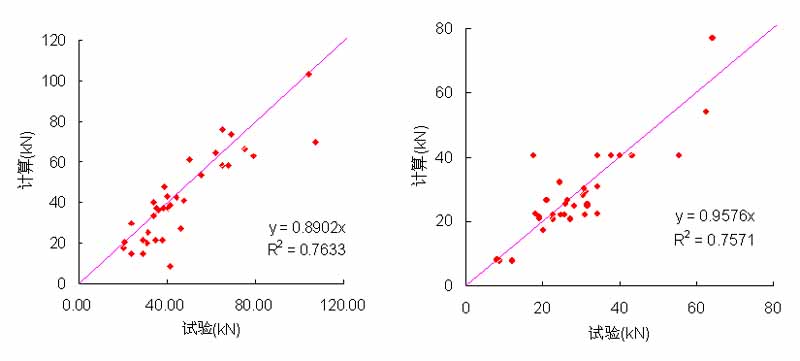
剥离破坏是外贴FRP片材加固混凝土梁主要的破坏形式。本研究提出了受剪剥离承载力计算公式。与大量试验结果的对比表明,该设计建议公式与试验结果吻合良好,可供设计应用参考。
论文下载
 点击下载
点击下载Size
Effects for Reinforced Concrete Beams Strengthened in Shear with CFRP
Strips
Journal
of Composites for Construction,2010
Abstract:
The principal motivation of this study is to obtain a clear understanding
of size effects for fiber-reinforced polymer (FRP) shear-strengthened
beams. The experimental program consists of seven beams of various sizes
grouped in three test series. One beam of each series is used as a benchmark
and its behavior is compared with a beam strengthened with a U-shaped
carbon FRP (CFRP) jacket. The third test series includes an additional
beam strengthened with completely wrapped external CFRP sheets. The
experimental results show that the effective axial strains of the CFRP
sheets are higher in the smaller specimens. Moreover, with a larger
beam size, one can expect less strain in the FRPs. A nonlinear finite-element
numerical analysis is developed to model the behavior of the CFRP shear-strengthened
beams. The numerical model is able to simulate the characteristics of
the shear-strengthened beams, including the interfacial behavior between
the concrete and the CFRP sheets. Three prediction models available
in current design guidelines for computing the CFRP effective strain
and shear contribution to the shear capacity of the CFRP shear-strengthened
beams are compared with the experimental results.
复杂应力状态对混凝土梁外贴FRP
条带抗剪贡献的影响
工程力学, 2008, 25(8): 127-132.
摘 要:FRP 剥离是外贴FRP 抗剪加固混凝土梁主要的破坏模式之一。以往研究中往往简单的将面内剪切试验得到的FRP-混凝土界面粘结滑移关系应用于外贴FRP
抗剪加固梁的剥离承载力计算。外贴FRP 抗剪加固梁中FRP下的混凝土的应力状态与面内剪切试验情况有较大差别,这对FRP-混凝土界面的力学性能具有较大的影响。因此,以往的方法高估了FRP
条带的抗剪贡献。该文研究了混凝土多轴应力状态对FRP-混凝土界面性能的影响,并根据试验研究结果,提出了U 形FRP 加固混凝土梁中FRP
剥离应变的折减系数。与试验结果的对比计算分析表明:使用该折减系数修正后的设计公式更加合理。
关键词:钢筋混凝土梁;FRP 抗剪加固;FRP-混凝土界面;三轴应力状态;界面剥离
FRP片材加固混凝土梁剥离承载力的计算及设计方法
建筑结构, 2007. 37(12): 79-82.
摘 要:粘贴FRP片材加固混凝土结构的界面剥离问题是FRP片材加固混凝土结构技术的关键基础问题。本文根据近年来对FRP片材加固混凝土的界面粘结性能、FRP片材加固混凝土梁的受弯和受剪剥离性能的试验和理论研究,介绍了FRP片材加固混凝土梁的抗弯和抗剪剥离承载力的计算和设计方法,及其有关保证剥离承载力的构造要求。
关键词:FRP片材,加固,剥离,界面
Numerical
modeling of FRP shear strengthened RC beams using compression field
theory
Proc. 3rd Int. Conf. for Composite in Civil Engineering
(CICE 2006), Miami, USA, 2006, 391-394.
Abstract:
The modified compression field theory and an advanced bond-slip model
are implemented in a general finite element analysis package to evaluate
the shear behaviour of FRP strengthened reinforced concrete beams. The
inclination angle of the critical shear crack is estimated and the debonding
phenomenon is simulated. A close agreement is achieved between the predicted
average FRP strains and those in a test beam reported in the literature.
Further research is being conducted to simulate behaviour of FRP shear
the interaction between the external FRP shear reinforcement and concrete.
keywords:
Shear, FRP, strengthening, concrete, modified compression field theory
(MCFT)
混凝土梁外贴FRP抗剪加固承载力计算
建筑结构. 36 (9), 2006, 31-36.
摘 要:剥离破坏是外贴FRP片材加固混凝土梁主要的破坏形式。本文回顾了对外贴FRP混凝土梁的试验研究、有限元分析和国内外现有的受剪剥离承载力计算公式。讨论了斜裂缝宽度分布规律,由此建立了FRP滑移分布模型,在此基础上分析了受剪剥离破坏时FRP的应力分布,讨论了FRP抗剪贡献与粘结长度、粘结方式等参数之间的关系。通过以上研究提出了受剪剥离承载力计算公式。与大量试验结果的对比表明,本文给出的设计建议公式与试验结果吻合良好,可供设计应用参考。
关键词:FRP,受剪剥离,加固,混凝土梁,斜裂缝,受剪承载力
U型FRP加固钢筋混凝土梁受剪剥离性能的有限元分析
工程力学, Engineering Mechanics, 22(4).2005.155-162
摘 要:采用FRP布对梁进行抗剪加固,可以有效的解决梁因配箍率不足而导致的受剪承载力偏低的问题。本文根据文献
[1] 中7根试验梁的参数,针对工程中常用的U型FRP受剪加固形式,建立三维有限元分析模型,采用商业有限元计算软件ANSYS,数值模拟了加载全过程和受剪剥离受力性能,根据试验结果确定了FRP-混凝土界面粘结剥离强度,并建议了合适的裂面剪力传递系数。根据有限元分析结果,作者又进一步研究了U型FRP布的应变分布、分担剪力的贡献、剥离破坏的过程,以及加固量、FRP类型和粘贴面积率对加固梁受剪承载力的影响。在有限元分析的基础上结合试验结果,建议了U型粘贴加固的受剪剥离承载力计算方法。
关键词:混凝土梁;FRP;加固;受剪承载力;有限元;剥离
Size
effect of shear contribution of externally bonded FRP U-jackets for
RC beams
Proc. International Symposium on Bond Behaviour of FRP
in Structures (BBFS 2005), Hong Kong, China, 2005. 371-380
ABSTRACT: It is well known that size effect exists in the shear strength of RC beams. Larger beams have a smaller nominal maximum shear strength. The size effect in RC beams shear strengthened with FRP has not been considered in existing predictive models. In these strengthened beams, the size effect may exist in the shear contributions of both RC beams and FRP. To better understand the shear strengthening and its corresponding size effect, a series of geometrically similar concrete beams strengthened with CFRP U-jackets were designed and tested in this study. The total shear strength of a strengthened RC beam is considered to consist of three components which are the shear contribution of the RC beam, and the direct and indirect shear contributions of the FRP. The direct shear contribution of FRP is obtained in this study with careful experimental measurements. An improved predictive model is proposed, which can obviously remove the size effect on direct FRP shear contribution. More studies are needed to quantify the indirect FRP shear contribution.
|
|
|
|
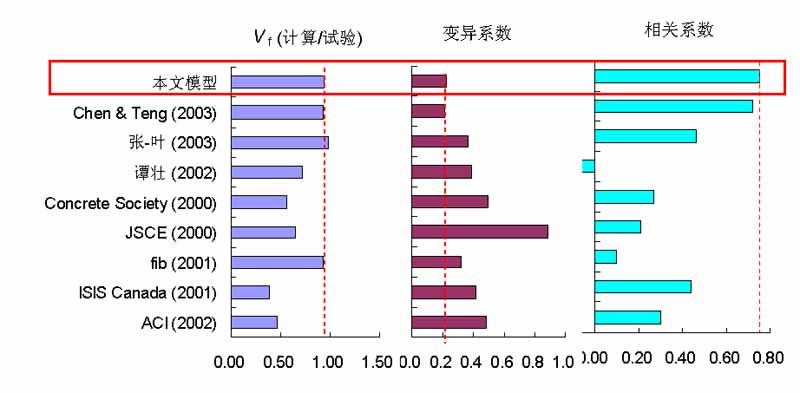
和世界上其他模型对比 |