Study on the Seismic Collapse Prevention
| Home | My Research |
 |
 |
 |
Paper download
 Download
Comparison
and selection of ground motion intensity measures for seismic design
of super high-rise buildings,
Advances in Structural Engineering, 2013, 16(7): 1249-1262..
Abstract: Ground motion intensity
measures (IMs) are an important basis of structural seismic design.
Extensive research has been conducted on the selection of IMs for building
structures with fundamental periods shorter than 6 s. However, minimal
work has been performed for super high-rise buildings whose fundamental
periods are much longer than 6 s. To fill the gap in this research area,
this paper aims to develop a simplified analytical model for super high-rise
buildings based on the flexural-shear coupled beam model. The variation
in correlation and dispersion between different IMs is evaluated and
the structural seismic response demand measures (DMs) are analyzed for
different structural fundamental periods. Subsequently, rational IMs
for the seismic design of super high-rise buildings are suggested. In
addition, the influence of different flexural and shear stiffness ratios,
a0, on the selection of an IM for super high-rise buildings is also
discussed. Finally, a series of incremental dynamic analyses (IDA) of
the Shanghai Tower, with a total height of approximately 632 m, is performed
to verify the rationality of using different IMs for super high-rise
buildings. The numerical results indicate that with a minimum dispersion,
the peak ground velocity (PGV) has a better correlation to the story
drift ratio than any other IMs. While considering structural nonlinearity,
PGV still yields the minimum coefficient of variation in the collapse
analysis of the actual super high-rise building. It is therefore recommended
that PGV be used as an IM for the seismic design of super high-rise
buildings.
Keywords: super high-rise building; collapse analysis; ground
motion intensity measure; simplified model.
An
improved ground motion intensity measure for super high-rise buildings,
Science
China Technological Sciences, 2013, 56(6): 1525-1533.
Abstract:
Ground motion intensity measure (IM) is an important part in performance-based
seismic design. A reasonable and efficient IM can make the prediction
of the structural seismic responses more accurate. Therefore, a more
reasonable IM for super high-rise buildings is proposed in this paper.
This IM takes into account the significant characteristic that higher-order
vibration modes play important roles in the seismic response of super
high-rise buildings, as well as the advantages of some existing IMs.
The key parameter of the proposed IM is calibrated using a series of
time-history analyses. The collapse simulations of two super high-rise
buildings are used to discuss the suitability of the proposed IM and
some other existing IMs. The results indicate that the proposed IM yields
a smaller coefficient of variation for the critical collapse status
than other existing IMs and performs well in reflecting the contribution
of higher-order vibration modes to the structural response. Hence, the
proposed IM is more applicable to seismic design for super high-rise
buildings than other IMs.
keywords: ground motion intensity measure, super high-rise building,
time-history analysis, collapse analysis
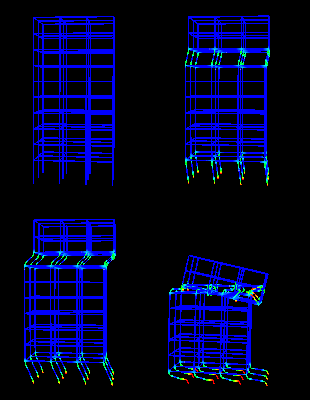
Collapse
simulation of reinforced concrete high-rise building induced by extreme
earthquakes,
Earthquake Engineering & Structural Dynamics, 2013,
42(5): 705-723.
Abstract: Collapse resistance of
high-rise buildings has become a research focus because of the frequent
occurrence of strong earthquakes and terrorist attacks in recent years.
Research development has demonstrated that numerical simulation is becoming
one of the most powerful tools for collapse analysis in addition to
the conventional laboratory model tests and post-earthquake investigations.
In this paper, a finite element method based numerical model encompassing
fiber-beam element model, multilayer shell model, and elemental deactivation
technique is proposed to predict the collapse process of high-rise buildings
subjected to extreme earthquake. The potential collapse processes are
simulated for a simple 10-story RC frame and two existing RC high-rise
buildings of 18-story and 20-story frame¨Ccore tube systems. The
influences of different failure criteria used are discussed in some
detail. The analysis results indicate that the proposed numerical model
is capable of simulating the collapse process of existing high-rise
buildings by identifying potentially weak components of the structure
that may induce collapse. The study outcome will be beneficial to aid
further development of optimal design philosophy.
Keywords: collapse simulation; high-rise buildings; elemental
deactivation; fiber-beam element model; multilayer shell model
Study
of collapse resistant capacity spectrum,
Journal
of Building Structures, 2012, 33(10): 1-7.
Abstract: This paper quantitatively
evaluates the earthquake-induced-collapse resistance of the single-degree-of-freedom
structural system through collapse fragility analysis based on incremental
dynamic analysis, and proposes the concept of the collapse resistant
capacity spectrum (referred to henceforth as the CRC spectrum). The
collapse resistant capacity spectrum is composed of the median (CRC50%)
spectrum and the dispersion (h) spectrum. The CRC spectrum is useful
to estimate the collapse probability of building structures subjected
to the earthquake of given intensity level; and also it is utilized
to establish the collapse probability targeted seismic design by which
the structure is designed to satisfy the prescribed collapse probability
under collapse-prevention-level earthquakes/mega-earthquakes. It is
proposed that, the elastic seismic forces demanded by the fortification-level
earthquake and the collapse-prevention-level earthquake/mega-earthquake
are reduced by the classical R-m-T relation and the CRC spectrum, respectively,
so as to rationally realize the three level seismic design target as
prescribed in the Chinese code for seismic design.
Keywords: Collapse Resistant Capacity Spectrum; Collapse Fragility
Analysis; R-m-T Relation; Performance-Based Seismic Design; Strength
Reduction Coefficient
Discussion
on the Ground Motion Intensity Measures for Super High-rise Buildings
China Civil Engineering Journal, 2012, 45(S1):292-296.
Abstract: Ground motion intensity
measure (IM) is an important basis for structural seismic design. A
simplified analytical model for super high-rise buildings on the basis
of the flexural-shear coupling beam model is developed in this work.
The variation of correlation and dispersion between different IMs and
the structural seismic response demand measures (DMs) are evaluated
for different structural fundamental periods. A series of incremental
dynamic analysis (IDA) of the Shanghai Tower, with a total height of
about 632 m, is carried out to verify the rationality of different IMs
for super high-rise buildings. The numerical results indicate that with
a minimum dispersion, PGV has a better correlation to story drift ratio
than any other IMs. It is therefore recommended that PGV can be used
as an IM for seismic design of super high-rise buildings.
Keywords: super high-rise building; collapse analysis; ground
motion intensity measure; simplified model
Single-degree-of-freedom
hysteretic model for collapse analysis of building structures,
Engineering Mechanics, 2012, 29(10): 5-12.
Abstract: A simplified single-degree-of-freedom
(SDOF) hysteretic model for collapse analysis of building structures
is proposed in this work. The simplified hysteretic model is capable
of simulating strength deterioration under monotonic loading, pinching,
strength and stiffness deterioration under cyclic loading as well as
P- effect, so that it can be applied to collapse analysis. To validate
the applicability and effectiveness of the proposed SDOF hysteretic
model, an eight-storey RC frame structure is simplified as an equivalent
SDOF system according to its fundamental mode of free vibration and
IDA-based collapse fragility analysis is implemented to the prototype
structure and simplified SDOF system, respectively. The results show
that the collapse fragility curves of the prototype structure and simplified
SDOF system agree quite well with each other.
Keywords: Collapse Fragility Analysis; Single-Degree-of-Freedom;
Hysteretic Model; Strength Deterioration; P-D Effect
Pseudo-static
collapse experiments and numerical prediction competition of RC frame
structure I: RC frame experiment,
Building Structure, 2012,42(11):19-22+26.
Abstract: In order to investigate
the seismic damage mechanism of reinforced concrete(RC) frame structures
during the Wenchuan Earthquake,a series of pseudo-static collapse experiments
of RC frame structure were carried out by Tsinghua University,including
one 3-story-4-span RC frame,two key beam-column joints and four key
columns.Numerical prediction competition is also conducted together
with the tests.The results of the experiments and numerical simulations
are published on the internet,which can be freely downloaded by the
researchers and engineers.The design,the experimental process and the
test results of the 3-story-4-span RC frame are introduced.
Key words: Wenchuan Earthquake; frame; collapse; reinforced concrete;
numerical simulation;
Abstract: In order to investigate
the seismic damage mechanism of reinforced concrete(RC) frame structures
during the Wenchuan Earthquake,a series of pseudo-static collapse experiments
of RC frame structure were carried out by Tsinghua University,including
one 3-story-4-span RC frame,two key beam-column joints and four key
columns.Numerical prediction competition is also conducted together
with the tests.The results of the experiments and numerical simulations
are published on the internet,which can be freely downloaded by researchers
and engineers.The design,the experimental process and the test results
of the 2 key beam-column joints and 4 key columns are introduced.
Key words: Wenchuan Earthquake; frame; collapse; reinforced concrete;
numerical simulation;
Pseudo-static
collapse experiments and numerical prediction competition of RC frame
structure III: simulation results analysis,
Building Structure, 2012, 42(11):27-30.
Abstract: In order to investigate
the seismic damage mechanism of reinforced concrete(RC) frame structures
during the Wenchuan Earthquake,a series of pseudo-static collapse experiments
of RC frame structure were carried out by Tsinghua University,including
one 3-story-4-span RC frame,two key beam-column joints and four key
columns.Numerical prediction competition is also conducted together
with the tests.The results of the experiments and numerical simulations
are published on the internet,which can be freely downloaded by researchers
and engineers.The results of numerical simulation competition for the
RC columns,joints and frames are introduced,and corresponding conclusions
and suggestions are proposed.
Key words: Wenchuan Earthquake; frame; collapse; reinforced concrete;
numerical simulation;
Seismic
damage simulation of urban buildings based on high performance GPU computing,
Journal of Natural Disasters, 2012, 21(5): 16-22.
Abstract: To meet the continuously increased
needs for seismic damage prediction,refined models have become an important
development trend in urban regional seismic damage prediction.However,the
application of refined models is limited by the high cost of computation
if it is implemented on traditional CPU platform.In recent years,a technology
with powerful parallel computing capability and lower cost,GPU technology,has
been developed and applied rapidly.In this paper,a simulating method
for urban regional seismic damage that can significantly reduce the
computation time,was developed based on GPU-CPU cooperative computing
technology.The proposed method was then applied to the seismic damage
simulation of a medium-sized city to illustrate the unique advantages
of GPU technology in large-scale regional seismic damage simulation.
Key words: urban region; seismic damage simulation; GPU; parallel
computing;
Study
on uniform collapse risk evaluation method for building structures under
earthquakes,
Journal of Building Structures, 2012, 33(6): 1-7.
Abstract: Seismic design should
quantitatively evaluate and control the earthquake collapse risk that
building structures are likely to encounter during the design service
life,which needs taking both the structural collapse resistant capacity
and the earthquake demand into consideration.Firstly,this paper introduced
IDA-based collapse fragility analysis and seismic hazard analysis,which
evaluated the structural collapse resisting capacity and the earthquake
demand in terms of probability,respectively.Furthermore,the structural
collapse probability was proposed for measuring the earthquake collapse
risk and its calculation method was provided.Finally,the collapse probabilities
of RC frame structure for three seven-fortification areas with different
seismic hazards were calculated as an example.The result shows the inadequacy
of evaluating earthquake collapse risk only based on seismic fortification.The
uniform-risk-targeted seismic design was proposed for collapse safety.
Key words: building structure; earthquake demand; collapse fragility;
seismic hazard; uniform-risk-targeted collapse safety;
Prediction
of seismic collapse vulnerability of RC frame based on pushover analysis
method,
Journal of Earthquake Engineering and Engineering Vibration,
2012, 32(4): 1-6.
Abstract: The collapse-vulnerability
analysis based on collapse probability is the most reasonable method
to evaluate the collapse resistant capacity of structures. However,
currently collapse probability analysis is mostly based on incremental
dynamic analysis (IDA), which is difficult to be directly used for engineering
design due to relatively large workload and complicated procedure. Therefore,
it is necessary to develop a new method, which is convenient for engineering
application. In this paper, 18 RC frames are analyzed respectively using
pushover analysis and IDA. Then, the correlation between the results
of pushover and those of IDA are studied. The results show that there
are fairly good correlated relations between the collapse margin ratio
(CMR), the collapse probability under maximal considered earthquake
(MCE) and the displacement margin ratio from pushover analysis. Based
on these relations, the design displacement margin ratio of pushover
analysis to meet the requirement of the collapse probability under MCE
is recommended. Nine additional RC frames are used to validate the proposed
displacement margin ratio, which shows this method is easy to implement
and can provide reference for engineering design of regular multilayer
RC frame.
Keywords: Pushover Analysis; Seismic Collapse Vulnerability;
IDA; Collapse Probability; Margin Ratio
A
hysteretic model of conventional steel braces and an analysis of the
collapse prevention effect of brace strengthening,
Applied Mechanics and Materials, 2012, 174-177: 3-10.
Abstract.
A hysteretic model of conventional steel braces consisting of 18 parameters
is proposed. This model is able to simulate the hysteretic behavior
of conventional steel braces accurately. The collapse-prevention strengthening
effect with steel braces for a typical reinforced concrete (RC) frame
that was close to the epicenter and collapsed during the Great Wenchuan
Earthquake is discussed via push-over analysis and collapse fragility
analysis based on incremental dynamic analysis. The result could be
referred to for the seismic collapse prevention design of RC frames.
Keywords: brace; hysteretic model, Wenchuan Earthquake; collapse
probability; strengthening.
Lessons
from the collapse of typical RC frames in Xuankou School during the
great Wenchuan Earthquake,
Advances in Structural Engineering, 2012, 15(1): 139-153.
Abstract: The seismic damage of
typical reinforced concrete (RC) frames in Xuankou School during the
Great Wenchuan Earthquake in China is introduced. A simulation method
for the seismic damage sustained was developed to enable analysis of
the damage mechanisms. The simulation makes use of different nonlinear
finite element (FE) models, including macro-scale fibre-beam-element
models and a micro-macro-scale hybrid model. The results of the nonlinear
FE simulations show that the design of RC frames do not properly allow
for the influence of slabs and footing rotations, which results in incorrect
predictions of the internal forces and hence, the seismic damage. The
collapse resistances of different buildings are compared using incremental
dynamic analysis (IDA). The IDA results show that the collapse resistance
of the classroom buildings is much lower than that of the office buildings
because the larger axial load ratio in classroom buildings limits their
lateral deformation capacity. An optimum design is proposed which would
improve the collapse resistances of classroom buildings at very low
cost.
Keywords: collapse; seismic damage; Wenchuan Earthquake; RC frames;
nonlinear finite element analysis
Influence
of three-dimensional ground motion input on IDA-based collapse fragility
analysis,
Earthquake Resistant Engineering and Retrofitting, 2011,
33(6): 1-7.
Abstract: Collapse safety is the
most important objective of performance-based seismic design, and IDA
(incremental dynamic
analysis)-based collapse fragility analysis is able to quantitatively
evaluate structural collapse safety under earthquakes. In this paper,
it is illustrated that IDA considering single horizontal component of
ground motion will over-estimate structural collapse safety through
examples of an 8-storey RC frame structure and a 20-storey RC frame-core
wall structure. More collapse modes may be appear with three-dimensional
ground motion input, so that more potential seismic vulnerability is
clearly exposed. Therefore, IDA considering three-dimensional ground
motion input should be adopted for collapse safety evaluation.
Keywords: incremental dynamic analysis; three-dimensional earthquake
ground motion; collapse mode; collapse safety subjected to earthquake
Study
on the seismic collapse resistance of RC frame structures with equal
spans in zones
with seismic intensity VII,
Journal of Earthquake Engineering and Engineering Vibration,
2011, 31(5): 13-20.
Abstract: The seismic design of
Chinese building structures is mostly depended on the structural elemental
loading capacity design under minor earthquake and the detailed design
to ensure the deformation capacity£® However£¬it
is lack of quantitative analysis of seismic collapse resistance under
severe earthquake£® And the actual seismic damage shows that
even for the same structural types£¬the global structural
parameters will greatly influence the seismic collapse resistances£®
Therefore£¬this paper designs 24 RC frame structures in zones
with seismic intensity VII according to the Chinese Seismic Design Code£¬which
have different spans£¬storey heights and storey number£®
Incremental dynamic analysis is performed for the structures to assess
their seismic collapse resistance£® The result shows that
global structural parameters£¬especially the span and the
storey number£¬have a great influence on the seismic collapse
resistance£®
Key words: frame structure; collapse resistance; incremental
dynamic analysis; elasto £ plastic dynamic analysis;
collapse probability
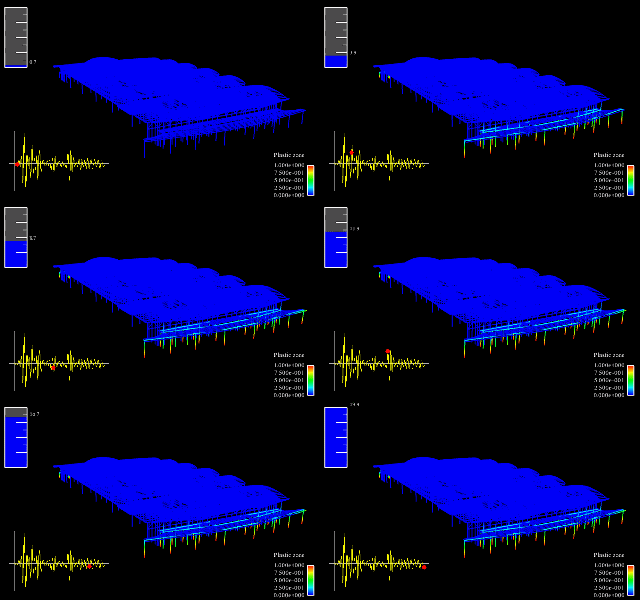
Collapse
simulation of a super high-rise building subjected to extremely strong
earthquakes
Sci
China Tech Sci, 2011, 54(10): 2549-2560.
Abstract: In
recent years, super high-rise buildings (>500 m) are developing very
quickly and become an important frontier of civil engineering. The collapse
resistance of super high-rise buildings subjected to extremely strong
earthquake is a critical problem that must be intensively studied. This
paper builds up a nonlinear finite element model of the tallest building
in China, Shanghai Tower (632 m), and proposes the modeling method and
failure criteria for different structural elements. The dynamic characters
of this building are then analyzed, and the possible failure modes and
collapse processes due to earthquakes are predicted, as well as the
corresponding collapse mechanism. This work will be helpful in collapse
prevention and the seismic design of super high-rise buildings.
Key words: super high-rise building, collapse simulation, extremely
strong earthquake, finite element method
Evaluation
of collapse resistance of RC frame structures for Chinese schools in
seismic design categories B and C
Earthquake
Engineering and Engineering Vibration, 2011, 10(3): 369-377.
Abstract: According to the Code for Seismic Design of Buildings (GB50011-2001), ten typical reinforced concrete (RC) frame structures, used as school classroom buildings, are designed with different seismic fortifi cation intensities (SFIs) (SFI=6 to 8.5) and different seismic design categories (SDCs) (SDC=B and C). The collapse resistance of the frames with SDC=B and C in terms of collapse fragility curves are quantitatively evaluated and compared via incremental dynamic analysis (IDA). The results show that the collapse resistance of structures should be evaluated based on both the absolute seismic resistance and the corresponding design seismic intensity. For the frames with SFI from 6 to 7.5, because they have relatively low absolute seismic resistance, their collapse resistance is insuffi cient even when their corresponding SDCs are upgraded from B to C. Thus, further measures are needed to enhance these structures, and some suggestions are proposed.
Study
on the effect of strengthening a typical RC frame in Wenchuan Earthquake
with attached substructures,
Journal of Architecture and Civil Engineering, 2011,
28(2): 21-27.
Abstract: This paper is based on
a typical RC frame that was closed to the epicenter and collapsed during
the Wenchuan Earthquake. The seismic collapse resistance of the frame
was strengthened by attached substructures, including conventional brace,
BRB brace and viscous damper. Collapse fragility analysis based on incremental
dynamic analysis is implemented for each strengthening scheme to compare
their effects and to analyze the influence of critical parameters. The
results show that the viscous damper performs better than the BRB brace,
and the BRB brace performs better than conventional brace. With the
same strengthening parameters, the A-shaped bracing scheme is better
than the X-shaped scheme.
Keywords: Wenchuan Earthquake, RC frame structure; collapse probability;
collapse prevention measure; strengthening.
Study
on the collapse-resistant capacity of RC frames with different seismic
fortification levels
Engineering Mechanics, 2011, 28(3): 41-48.
Abstract: Collapse safety is the
most important objective of performance-based seismic design. Buildings
should have enough safety margin to avoid collapse during severe or
mega earthquake. However, current Chinese seismic design code does not
have explicit design specification or quantitative evaluation for collapse-resistant
capacity. In this paper, the collapse-resistant capacities and safety
margins against collapse of multi-story reinforced concrete (RC) frames
with different seismic fortification levels are quantitatively evaluated,
with collapse fragility analysis which is based on incremental dynamic
analysis (IDA). The influences of axial compression ratio and the collapse
mechanism on the collapse-resistant capacity are discussed, and suggestions
are proposed to improve current design.
Keywords: frame structure; incremental dynamic analysis; seismic
fortification intensity; collapse mechanism; safety margin against collapse
Comparison
of different strengthening methods for a typical RC classroom frame
in 7-fortification level zone,
Journal of Earthquake Engineering and Engineering Vibration,
2011, 31(1): 124-129.
Abstract: In the Wenchuan Earthquake,
many school buildings collapsed which caused huge casualties. So after
the earthquake, Ministry of Housing and Urban-Rural Development, China
Academic of Engineering, and China Earthquake Administrator proposed
different strengthening methods to upgrade the seismic design of school
buildings. However, the actual effects of these proposals have not been
quantificationally evaluated. So in this work, fiber-beam element model
with validated stirrups confined concrete constitutive law is used to
buildup the nonlinear finite element model of a typical reinforced concrete
(RC) classroom frame in 7-fortification level zone during the Wenchuan
Earthquake. The effects of different strengthening methods on collapse-prevention
are studied with collapse-fragility analysis that is based on incremental
dynamic analysis (IDA). Further design suggestions are then proposed.
Key words: Wenchuan Earthquake; RC frame structure; collapse
possibility; collapse-prevention; strengthening method
A
pushover analysis algorithm based on multiple point constraints,
Engineering Mechanics, 2011, 28(2): 18-23.
Abstract: This paper proposes a
new numerical method for pushover analysis. By using multiple point
constraints, the lateral force distribution is maintained and displacement-controlled
pushover analysis is achieved. The method is derived from the principle
of virtual work and the rigidity of multiple point constraint. It is
applicable to both elastic and inelastic structures. The proposed pushover
analysis method can be implemented with user-defined subroutine interfaces
of finite element software MSC.MARC. The outstanding performance of
the method is then demonstrated using monotonic and cyclic pushover
analysis of reinforced concrete structures. The evolution of deterioration
from onset to eventual member and structural failure can be tracked,
suggesting that the proposed method is a powerful tool offering complete
pictures and considerable insight into pushover performance and collapse
mechanism of structures.
Keywords: pushover analysis, multiple point constraint, displacement
control; principle of virtual work; collapse analysis
Research
strategy on the building seismic design method that is aimed to control
the collapse possibility under strong and mega earthquakes,
Proc. 8th National Earthquake Engineering Conference,
2010.12, Chongqing, China: 291~297.
Seismic
damage investigation and analysis on RC frames in Yushu 4.14 Earthquake,
Journal of Civil, Architectural and Environmental Engineering,
2010, 32(sup.2): 6-8.
Abstract: Yushu 4.14 Earthquake
made serious damage to buildings. Sent by Ministry of Housing and Urban-Rural
Development of the P.R. China, authors made an investigation on the
seismic damage of buildings in Yushu autonomous county, and special
investigation was made on the damage condition and characteristic of
RCframe buildings. Some suggestions are proposed in this paper.
Keywords: Yushu earthquake; frame structure; seismic damage investigation;
Study
on the influence of stirrups confinement to the collapse resistance
of typical RC frame in Wenchuan Earthquake
Journal of Civil, Architectural and Environmental Engineering,
2010, 32(sup.2): 322-325.
Abstract: The lateral confinement
of steel stirrups can improve the deformation capacity of kernel concrete,
which will increase the global collapse resistance of the reinforced
concrete (RC) frames. Existing stress-strain models of stirrups confined
concrete are summarized and compared with test results to validate their
accuracies. Then with validated stirrups confined concrete models and
incremental dynamic analysis (IDA), the collapse resistance of a typical
RC frame in Wenchuan Earthquake is quantificationally evaluated. The
influence of stirrups confinement to the collapse resistance is discussed.
Key words: stirrups confined concrete, constitutive models, fiber
beam model, collapse resistance, Incremental Dynamic Analysis
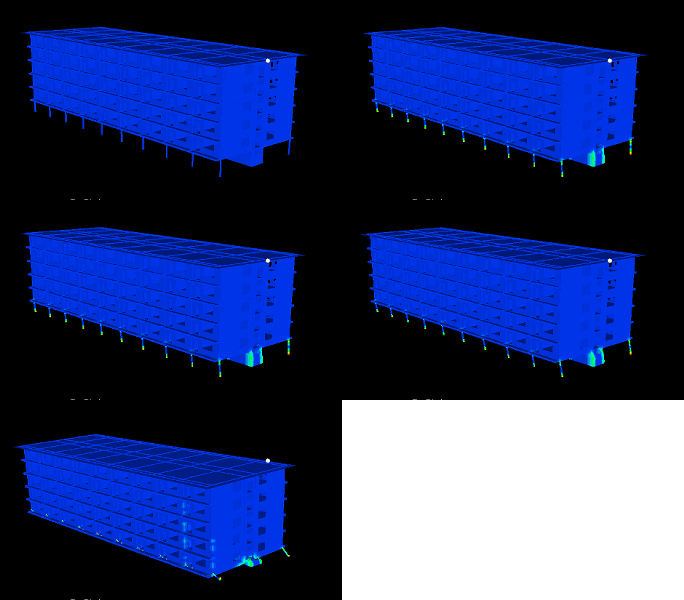
Numerical
models for the progressive collapse of high-rise buildings due to earthquake,
Engineering Mechanics, 2010, 27(11): 64-70.
Abstract: Progressive collapse means
the collapse of whole building due to local weak stories or weak zones.
Though collapse should theoretically be avoid for any buildings under
any earthquake, it is important to study the collapse behavior of buildings
to get a better understanding for the collapse mechanism and to find
efficient method against it. The collapse process highly depends on
the whole structural system, numerical simulation becomes a major method
to study it. With the numerical program developed by the authors for
the collapse simulation of complicated structures, the extreme nonlinear
behavior of structural elements can be properly simulated. Two real
buildings are analyzed to study the failure mechanism of the structures.
The models proposed are helpful to study the collapse mechanism of high-rise
seismic buildings.
Keywords: disaster prevention and mitigation; progressive collapse;
earthquake; numerical model; nonlinear; reinforced concrete
Study
on the effect of strengthening a typical RC frame in Wenchuan Earthquake
with BRB brace,
Journal of Catastrophology, 2010, 25(S0): 157-160.
Abstract: This paper is based on
a typical RC frame that was closed to the epicenter and collapsed during
the Wenchuan Earthquake. The seismic collapse resistance of the frame
was strengthened by BRB brace. Collapse fragility analysis based on
incremental dynamic analysis is implemented for each strengthening scheme
to compare their effects and to analyze the influence of critical parameters.
The results show that the BRB brace performs better than the conventional
brace. With the same strengthening parameters, the A-shaped bracing
scheme is better than the X-shaped scheme.
Keywords: Wenchuan Earthquake, RC frame structure; collapse probability;
collapse prevention measure; strengthening.
Influence
of axial compression ratio to the seismic collapse resistance of RC
frame structures
Earthquake Resistant Engineering and Retrofitting, 2010,
32(5): 26-35.
Abstract: The seismic collapse resistances
of 24 reinforced concrete (RC) frame structures (in 7-degree seismic
intensity zone, with different span, storey height and storey number)
which are designed according to the Chinese Seismic Design Code are
analysis with fiber-beam element model and incremental dynamic analysis
(IDA) that is recommended by ATC-63 Report. The results show that the
axial compression ratio of columns is the most important factor affecting
seismic collapse resistance of these structures and there is a negative
linear correlation between axial compression ratio of columns and collapse
margin ratio of structures. The upper limit of current seismic design
code is too big which mostly results in the lack of collapse resistance
of frame structures. Then, the axial compression ratio of all structures
is unified by adjusting their column size and the modified structures
are analyzed again, which shows that by controlling the axial compression
ratio, the seismic collapse resistance is obviously improved.
Keywords: frame structure; collapse performance; incremental
dynamic analysis; collapse
Study
on the seismic collapse resistance of structural system,
Earthquake Resistant Engineering and Retrofitting, 2010,
32(1): 13-18.
Abstract: Structural system is very important for the collapse resistance of structures under extreme disasters. But currently there is still lack of quantitative evaluation method for structural system. This paper takes aseismic structures as examples, discusses the safety margins of structures, and points out that the structural safety margin is make up of safety margin that is beneath the structural element level and the safety margin of global structural system. Factors that may control the safety margin of global structural systems is then analyzed. In order to give a better evaluation for the safety of whole structure, Collapse Margin Ratio (CMR) is introduce, which is based on Incremental Dynamic Analysis (IDA) and is receiving more international focus recently. Frame examples are given to illustrate how to evaluate the structural collapse resistance under Mega-earthquake with CMR.
Seismic
collapse resistance of RC frame structures
----Case studies on the seismic damage of several RC frame structures
under extreme ground motion in Wenchuan Earthquake,
Journal of Building Structures, 2009, 30(6): 67-76.
Abstract: The seismic damage of
several groups of RC frames in the hardest-hit zone of Wenchuan Earthquake
is introduced. In each group, some frames collapsed while others survived,
despite that they have similar site conditions. The collapse resistances
of two typical frames in earthquake are analyzed with nonlinear time-history
analysis, pushover analysis and collapse margin ratio (CMR) analysis
which is based on incremental dynamic analysis (IDA). The corresponding
collapse resistance researches and calculation methods in foreign countries
are introduced. The main influencing factors and the evaluation indices
that control the structural collapse resistance, as well as the global
redundancy and integrity, are discussed. Based on this study, the collapse
resistance of frames can be effectively improved with the following
methods: (1) Guarantee the global loading resistance capacity and lateral
deformation capacity; (2) Increase the redundancy and integrity; (3)
Achieve rational yield mechanism with proposed engineering method; (4)
Buildup dual-system for frame structures with infill walls. Finally,
the problems that may need further researches on structural collapse
are proposed.
Keywords: Wenchuan Earthquake; RC frame; collapse; elastic-plastic
analysis; collapse margin ratio; redundancy; integrity
Influence
of structural parameters to the seismic collapse resistance of RC frames
in 7-degree seismic fortification zone,
Proc. 4th Int. Conf. on Protection of Structures Against
Hazards, Oct. 2009, Beijing, China: 331-338.
Abstract: Currently in China structural
seismic design mostly focuses on design and verification of member strength
under minor earthquake. However, during actual earthquakes, structural
systems play a more important role in seismic collapse resistance. Therefore,
in order to find the influence of structural parameters to the seismic
collapse resistance, this paper designs 24 reinforced concrete (RC)
frames in 7-degree seismic fortification zone according to the Chinese
Seismic Design Code, which have different spans, storey heights and
storey numbers. Incremental dynamic analysis (IDA), recommended by ATC-63
Report, is implemented for the frames based on fiber-beam element model
to evaluate their seismic collapse resistances. The result shows that
structural parameters have a great influence to seismic collapse resistance.
The seismic collapse resistance of frames designed according to the
Chinese Seismic Design Code with different span has obvious difference.
The result could be referred for the further study of seismic collapse
resistance.
Keywords: frame structure, collapse performance, incremental
dynamic analysis, nonlinear dynamic analysis, collapse probability
Analysis
on damage mechanism of a typical RC frame in Wenchuan Earthquake
China Civil Engineering Journal, 2009, 42(5): 13-20.
Abstract: Many RC frame structures
were damaged seriously with plastic hinges occurred at column ends rather
than beam ends in the Wenchuan earthquake, which is significantly different
to the failure mode expected in the seismic design. Based on the investigation
of a typical RC frame structure damaged in the earthquake area, time
history analyses using sophisticated finite element method were conducted.
Three models were considered, i.e. pure frame, frame with floor slab,
and frame with both floor slab and infill wall. A ground motion recorded
at Bajiao town in the earthquake was used for the analyses, and comparison
between three models were carried out to investigate the effect of floor
slab and infill wall on the structural base shear, distribution of plastic
hinges, and failure mechanism. Major finding from the analysis results
are as follows: 1) ¡°strong column weak beam¡±
is not able to achieve for the RC frame designed by following current
Chinese design code. 2) Infill walls significantly change the failure
mechanism of the RC frame. 3) Soft story mechanism is prone to occur
for the structure with non-uniform distributed infill walls. The findings
suggest that the effects of floor slab and infill wall have to be considered
in the seismic design, and increasing stiffness and strength of columns
is needed to achieve ¡°strong column weak beam¡±.
Keywords: RC frame; seismic performance; floor slab; infill wall;
finite element model; collapse mechanism
Numerical
simulation for the progressive collapse of concrete building due to
earthquake
Proc. the 14th World Conference on Earthquake Engineering,
October 12-17, 2008, Beijing, China, CDROM.
ABSTRACT : Collapse is a critical
ultimate state for buildings under earthquake. Though collapse should
theoretically be avoid for any buildings under any earthquake, it is
still very important to study the collapse behavior of buildings so
as to get a better understanding for the collapse mechanism and to find
efficient method to against it. Progressive collapse, which means that
collapse of whole building due to local weak stories or weak zones,
is a most common failure mode in earthquake. And as its collapse process
highly depends on the whole structural system, numerical simulation
becomes a major method to study it. With the fiber-beam-element model
and multi-layer-shell-element model, which is developed by Tsinghua
University for reinforced concrete (RC) frames and RC shear-walls respectively,
the extreme nonlinear behavior of RC structural elements can be properly
simulated including the cycle behavior under coupled axial force-bending
moment-shear force, the breakdown of structural elements at ultimate
states, and the contact between structural elements during the collapse.
Simple RC frames and RC frame-shear wall structures are firstly used
to demonstrate and to benchmark the capacity of the numerical model,
and real complicated buildings are analyzed to study the failure mechanism
of the structures.
KEYWORDS: progressive collapse, earthquake, numerical model,
nonlinear, reinforced concrete
Analysis
on Building Seismic Damage in Wenchuan Earthquake
Journal
of Building Structures, 2008, 29(4): 1-9.
Abstract: On May, 12, 2008, an earthquake
with a magnitude of 8.0 happened in Wenchuan, Sichuan Province. The
earthquake resulted in a large number of collapses and damages of buildings,
and brought huge loss to the people's lives and properties. This paper
gathers the building seismic damage data in major disaster area from
the investigation work of the civil and structural groups of Tsinghua
University, Xinan Jiaotong University and Beijing Jiaotong University.
The data are classified according to structural type, construction time,
earthquake intensity and function of usage. The characters of building
seismic damage in this earthquake is analyzed with typical building
damage cases, and the lessons are concluded on structural type selection,
structural design and construction management and so on.
Keywords: Wenchuan earthquake, Seismic damage analysis, seismic
damage cases